
Enterprise AI is moving beyond chatbots that simply answer questions. Businesses now want AI systems that can understand instructions, retrieve company information, interact with software applications, and complete multi-step tasks within defined permissions.
Consider a finance team reviewing hundreds of invoices, a healthcare organization managing patient appointment requests, or an iGaming operator handling player support queries. These processes involve multiple systems, business rules, and decisions. An AI agent can help coordinate such work while keeping employees involved in important decisions.
However, building an enterprise-ready AI agent requires more than connecting a large language model (LLM) to an application. It involves the right architecture, reliable data retrieval, API integrations, security controls, testing, and ongoing monitoring.
For organizations planning an AI implementation in 2027, understanding these components is essential before investing in development.
This guide explains how to build enterprise AI agents, select an appropriate architecture, implement Retrieval-Augmented Generation (RAG), manage security risks, and estimate development costs.
Key Takeaways
- Start with a business problem: Identify a repetitive or complex workflow before choosing an AI model or development framework.
- Choose the right architecture: A single-agent system is often sufficient for focused tasks, while multi-agent systems can support more complex workflows.
- Connect AI with business data: RAG helps agents retrieve relevant information from approved company knowledge sources.
- Build security into the system: Role-based access, tool permissions, human approvals, and audit logs are important for enterprise deployments.
- Plan for long-term operating costs: Model usage, integrations, infrastructure, testing, monitoring, and maintenance all affect the total investment.
What Are Enterprise AI Agents?
An enterprise AI agent is a software system that uses an AI model to understand a task, determine the next steps, interact with approved tools, and work toward a defined business outcome.
Unlike a conventional chatbot, which primarily responds to user questions, an AI agent can perform actions through connected applications and APIs.
For example, a customer support agent may:
- Understand a customer’s request.
- Retrieve relevant information from a knowledge base.
- Check the customer’s account through an authorized API.
- Identify the appropriate resolution.
- Create or update a support ticket.
- Escalate the request when human assistance is necessary.
The agent does not need unrestricted access to every business system. Its capabilities should be limited to the tools, data, and permissions required for its assigned responsibility.
AI Chatbot vs. AI Agent vs. Enterprise AI Agent
|
Feature |
Traditional chatbot |
AI agent |
Enterprise AI agent |
|
Primary purpose |
Answer questions |
Complete tasks |
Execute business workflows |
|
Decision-making |
Mostly predefined |
Model-assisted |
Model-assisted with policies |
|
Tool access |
Limited |
Connected tools |
Controlled enterprise integrations |
|
Data access |
FAQs or predefined content |
External tools and data |
Permission-aware business data |
|
Human involvement |
User-driven |
Based on workflow |
Approval and escalation controls |
|
Monitoring |
Conversation logs |
Task execution logs |
Operational and security monitoring |
The important difference is not simply how intelligent a system appears. It is how reliably it operates within an organization’s existing processes.
Why Businesses Are Investing in Enterprise AI Agent Development in 2027
AI adoption is increasingly focused on practical implementation rather than experimentation alone.
Organizations want solutions that can reduce repetitive work, improve information access, support employees, and connect disconnected applications.
Enterprise AI agent development addresses these requirements by combining language models, business data, APIs, and workflow automation.
Here are some important business applications.
1. Customer Support and Service Operations
Customer support teams frequently handle repetitive questions about orders, subscriptions, account access, billing, and service requests.
An AI agent can retrieve relevant information, classify incoming queries, check approved account details, and prepare responses.
More complex issues can be transferred to a human representative with the conversation context attached.
2. Finance and Banking Operations
Financial organizations can use AI agents to support document processing, customer onboarding, transaction review, and internal reporting.
For example, an onboarding agent could collect submitted information, check whether required documents are available, and route incomplete applications for review.
For sensitive financial decisions, the system should follow established policies and require authorized human approval where appropriate.
3. Healthcare Administration
Healthcare organizations can use agents to assist with appointment scheduling, patient intake, administrative documentation, and information retrieval.
An appointment agent, for instance, could check available slots through an authorized scheduling system and help patients request a suitable appointment.
Access to protected health information must be carefully controlled. AI agents should not independently make clinical decisions or replace qualified medical professionals.
4. iGaming and Digital Platforms
iGaming platforms involve multiple operational workflows, including player onboarding, customer support, payment queries, account verification, and fraud monitoring.
An AI agent can assist support teams by retrieving account information, categorizing requests, and escalating suspicious activity for investigation.
These systems must respect platform permissions, responsible gaming requirements, and applicable jurisdiction-specific regulations.
5. Internal Business Operations
Companies can also deploy agents for employee support, document retrieval, reporting, procurement assistance, and internal knowledge management.
For example, an internal operations agent could retrieve an approved company policy, summarize relevant information, and guide an employee through the correct process.
The best starting point is usually a workflow with clear inputs, measurable outcomes, and manageable risks.
How to Build Enterprise AI Agents: Step-by-Step Development Process
Successful implementation starts with business requirements and progresses through architecture, integration, testing, and deployment.
The following development process provides a practical approach.
Step 1: Identify the Business Problem and Define the Use Case
Before selecting a model, identify the task the agent is expected to perform.
Ask:
- Which business process requires automation?
- How frequently is the task performed?
- Which applications and data sources are involved?
- What decisions can the agent make?
- When should a human take over?
- How will success be measured?
For example, a company may want an agent to process incoming support requests.
Its objective could be to classify requests, retrieve relevant documentation, suggest resolutions, and create tickets.
Define measurable performance indicators such as task completion rate, response accuracy, escalation rate, processing time, and cost per completed task.
A clearly defined use case prevents unnecessary complexity during development.
Step 2: Assess Data and Existing Systems
Enterprise agents are only as useful as the information and tools they can access.
Before development, review the organization’s:
- Databases and data warehouses
- Internal documents and knowledge bases
- CRM and ERP applications
- Customer support platforms
- Existing APIs and third-party services
- User roles and access permissions
Data quality also matters. Outdated documents, duplicate records, inconsistent formats, and missing information can affect agent responses.
Create a data inventory and identify which information the agent actually needs.
This stage also helps determine whether the organization requires RAG, direct database access, API integrations, or a combination of these approaches.
Step 3: Select the Right AI Model and Development Framework
The model should be selected according to the task, accuracy requirements, latency, privacy expectations, and operating budget.
Some workflows require advanced reasoning, while others can work with smaller, faster models.
Common technology options include:
|
Technology |
Potential application |
|
OpenAI models |
Language understanding, reasoning and tool use |
|
Anthropic Claude |
Document analysis and complex language tasks |
|
Open-source LLMs |
Custom deployments and greater infrastructure control |
|
LangChain |
Connecting models, tools and data workflows |
|
LangGraph |
Stateful and controlled agent workflows |
|
CrewAI |
Coordinating specialized agents |
|
Python and FastAPI |
Backend development and API services |
|
Pinecone / pgvector |
Vector search and retrieval |
These technologies are not interchangeable solutions. Their suitability depends on the requirements, ecosystem, deployment environment, and engineering capabilities of the project.
For example, a single-agent workflow may only need model integration, a few APIs, and appropriate guardrails. A complex workflow may benefit from a graph-based orchestration framework.
Step 4: Design the Enterprise AI Agent Architecture
Architecture determines how the agent processes requests, retrieves information, communicates with external systems, and handles failures.
A typical enterprise AI agent architecture includes several connected components.
- User Interface Layer
Employees or customers interact with the agent through a web application, mobile application, internal portal, or communication interface.
- Application and API Layer
This layer handles authentication, request validation, business logic, and communication with existing enterprise applications.
- Agent Orchestration Layer
The orchestration component manages task execution, tool selection, workflow state, and the sequence of operations.
- AI Model Layer
An LLM interprets instructions, generates responses, and determines appropriate next actions within the defined workflow.
- Knowledge and Retrieval Layer
RAG and other retrieval methods provide relevant information from approved enterprise data sources.
- Integration Layer
The agent communicates with authorized CRMs, ERPs, databases, ticketing platforms, and other systems through APIs or approved tools.
- Security and Monitoring Layer
Authentication, permissions, logging, validation, monitoring, and human approvals help control how the system operates.
These components may be implemented as separate services or combined in a smaller application, depending on scale and complexity.
Enterprise AI Agent Architecture: How the Components Work Together
A simplified workflow looks like this:
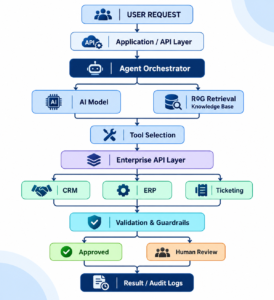
The agent should not execute every proposed action automatically. Validation and authorization must happen before sensitive operations are performed.
Step 5: Implement Retrieval-Augmented Generation (RAG)
One major challenge in enterprise AI is giving language models access to relevant company information without relying entirely on their pre-existing training knowledge.
Retrieval-Augmented Generation addresses this challenge.
RAG combines information retrieval with language generation. Instead of asking an LLM to answer only from its general knowledge, the application first retrieves relevant information from an approved knowledge source and provides that context to the model.
How Does RAG Work?
A typical RAG pipeline includes these stages:
- Data collection: Gather relevant documents, policies, product information, and internal records.
- Document processing: Extract text, clean information, and divide documents into manageable chunks.
- Embedding generation: Convert text chunks into numerical representations called embeddings.
- Vector indexing: Store embeddings and associated metadata in a vector database or search index.
- Query processing: Convert the user’s question into a retrieval query.
- Context retrieval: Find relevant documents using semantic or hybrid search.
- Response generation: Provide retrieved context to the LLM to generate a grounded response.
- Validation: Check response quality, permissions, and source relevance.
For example, when an employee asks about a company’s refund policy, the agent can retrieve the current approved policy document and use it to formulate an answer.
This is more useful than relying on a model’s general knowledge for company-specific information.
Important RAG Components
|
Component |
Purpose |
|
Data ingestion |
Collects business information |
|
Document chunking |
Divides content into searchable sections |
|
Embeddings |
Represents text for semantic retrieval |
|
Vector database |
Stores searchable vector representations |
|
Retrieval engine |
Finds relevant information |
|
Reranking |
Improves the relevance of retrieved results |
|
LLM |
Generates an answer using retrieved context |
|
Access controls |
Restrict retrieval to authorized information |
RAG does not automatically guarantee accurate answers. Poor document quality, incorrect retrieval, outdated information, and weak access controls can still create problems.
Microsoft’s technical guidance on Retrieval-Augmented Generation also emphasizes retrieval evaluation, document-level access control, and security considerations.
Step 6: Integrate APIs and Enterprise Applications
An AI agent becomes operationally useful when it can interact with the systems employees already use.
Common integrations include:
- CRM platforms for customer records.
- ERP systems for business operations.
- Payment gateways for transaction information.
- Ticketing platforms for support workflows.
- Internal databases for approved business records.
- Communication tools for notifications.
For example, a support agent may retrieve a customer’s subscription status through an API, check the relevant policy, and create a ticket if the issue requires further attention.
API integration should include authentication, input validation, error handling, rate limits, logging, and clear permission boundaries.
A failed API request should not be treated as a successful business action.
Step 7: Build Security, Guardrails and Human Approval
Security is a core architectural requirement, not an optional feature added before launch.
Enterprise agents can interact with sensitive information and perform actions across multiple applications. A poorly controlled agent may expose data, execute unintended actions, or follow malicious instructions.
Important safeguards include:
- Role-based access control (RBAC).
- Encryption in transit and at rest.
- Secure API authentication.
- Data masking and sensitive information handling.
- Input and output validation.
- Prompt-injection protection.
- Tool-level permissions.
- Human approval for high-impact actions.
- Audit logs and incident monitoring.
For example, an agent may be allowed to prepare a payment request but should not automatically approve or execute a high-value transaction without the required authorization.
Step 8: Test, Deploy and Monitor the Agent
An AI agent that performs well in a demonstration may behave differently when exposed to real business data and user requests.
Testing should cover:
Functional testing: Does the agent complete its assigned tasks?
Accuracy testing: Does it retrieve and use the correct information?
Integration testing: Do connected APIs and enterprise applications behave correctly?
Security testing: Can unauthorized users access restricted data or trigger prohibited actions?
Performance testing: Does the system respond within acceptable time limits under expected workloads?
Failure testing: What happens when an API is unavailable, a document is missing, or the model produces an uncertain answer?
After testing, deploy the agent in a controlled environment and gradually expand its access and workload.
Production monitoring should track task success, response quality, latency, token consumption, API failures, escalation rates, and unusual activity.
Single-Agent vs. Multi-Agent AI Systems: Which Should Enterprises Choose?
Not every enterprise workflow requires multiple AI agents.
A single-agent architecture is often easier to develop, test, maintain, and monitor. It works well when one agent can complete a clearly defined task using a manageable set of tools.
Multi-Agent AI Systems become useful when a workflow requires different responsibilities, specialized context, or independent stages of work.
For example, an enterprise research workflow might use:
- Research Agent: Collects information from approved sources.
- Analysis Agent: Reviews and organizes the retrieved information.
- Validation Agent: Checks results against defined rules.
- Reporting Agent: Prepares the final output.
An orchestrator coordinates these agents and manages the workflow.
|
Comparison |
Single-agent system |
Multi-agent system |
|
Workflow |
Focused tasks |
Multiple specialized tasks |
|
Architecture |
Simpler |
More complex |
|
Coordination |
One agent |
Orchestrator and agents |
|
Testing |
Relatively straightforward |
Requires interaction testing |
|
Cost |
Often lower |
Can be higher |
|
Best suited for |
Defined business processes |
Complex workflows with distinct responsibilities |
Practical recommendation: Start with a single agent wherever possible. Introduce multiple agents only when specialization provides a measurable advantage over a simpler architecture.
Enterprise AI Agent Development Cost in 2027
The cost of building enterprise AI agents depends on the scope of the project, technology choices, integration requirements, security controls, and deployment environment.
There is no reliable universal price for every enterprise AI agent.
A focused internal assistant and a multi-agent platform connected to several enterprise applications require very different levels of engineering effort.
Major Factors That Influence Development Cost
|
Cost factor |
What affects the investment |
|
Project complexity |
Number of tasks and workflow steps |
|
AI model |
Model selection, usage and inference requirements |
|
RAG implementation |
Data volume, indexing and retrieval complexity |
|
Integrations |
Number and complexity of APIs |
|
Security |
Authentication, permissions and audit requirements |
|
Infrastructure |
Cloud hosting, databases and scaling |
|
Testing |
Accuracy, performance and security validation |
|
Maintenance |
Monitoring, model updates and ongoing support |
Development Scope and Cost Considerations
- Single-purpose AI agent
A focused agent with limited tools, a clearly defined workflow, and basic integrations generally requires less development effort.
- RAG-enabled enterprise assistant
A knowledge assistant requires document processing, indexing, retrieval evaluation, permissions, and model integration.
- Integrated enterprise AI agent
A solution that communicates with multiple business applications needs additional backend development, API management, access control, and workflow testing.
- Multi-agent enterprise platform
A coordinated system with multiple specialized agents requires more orchestration, state management, monitoring, testing, and infrastructure planning.
How to Estimate the Actual Project Budget
Before requesting an AI agent development quote, prepare answers to these questions:
- What business process should the agent handle?
- How many applications must it connect with?
- Does it require access to private company data?
- Is RAG necessary?
- Will one agent be sufficient?
- Which actions require human approval?
- What are the expected number of users and requests?
- What security and compliance requirements apply?
A development team can use these details to prepare a realistic estimate based on project scope rather than offering an arbitrary fixed price.
Also, distinguish initial development costs from recurring expenses such as model usage, hosting, storage, API subscriptions, monitoring, and maintenance.
Common Mistakes to Avoid When Building Enterprise AI Agents
Even a well-selected AI model cannot compensate for poor system design.
Some mistakes can increase development costs and create operational risks.
Choosing technology before defining the use case: Start with a business requirement, not a trending framework.
Giving agents excessive permissions: Provide only the access required for the assigned task.
Ignoring data quality: Outdated or inconsistent documents can reduce retrieval quality.
Overcomplicating the architecture: Multiple agents are not automatically better than one well-designed agent.
Skipping evaluation: Test real-world scenarios, edge cases, and failure conditions before deployment.
Ignoring operating costs: Monitor token usage, retrieval operations, infrastructure, and integration expenses.
Treating deployment as the finish line: Production agents require continuous monitoring, updates, and performance improvements.
How to Choose the Right Enterprise AI Agent Development Company
Choosing a development partner is an important decision because enterprise AI projects involve more than model integration.
Before selecting an AI Agent Development Company, evaluate the following areas:
- Technical expertise: Does the team understand LLMs, RAG, APIs, backend engineering, and agent orchestration?
- Enterprise integration: Can it work with existing databases, CRMs, ERPs, and business applications?
- Security practices: Does it understand access controls, data protection, validation, and auditability?
- Development methodology: Is there a structured process for requirements, architecture, testing, and deployment?
- Scalability: Can the proposed architecture support future users, workflows, and integrations?
- Ongoing support: Is there a plan for monitoring, maintenance, and performance optimization?
A good development partner should also be willing to explain technical trade-offs and recommend a simpler solution when a complex AI architecture is unnecessary.
Build Enterprise AI Agents with Trisha Global Tech
Building a reliable enterprise AI agent requires a combination of AI engineering, software development, data integration, and workflow design.
Trisha Global Tech works on custom AI agent development for iGaming, FinTech, Healthcare, and back-office operations. Its AI agent capabilities include single-agent and multi-agent architectures, tool and function calling, API integration, RAG pipelines, guardrails, human approval workflows, and monitoring.
The development approach starts with understanding the business use case, mapping data and tools, designing the architecture, and testing the agent against real operational scenarios before deployment.
Alongside AI agent development, Trisha Global Tech also provides enterprise software development, API development and integration, AI and machine learning, and related software engineering services.
Whether your organization is planning an internal knowledge assistant, an AI-powered operational workflow, or a more complex multi-agent application, the right starting point is a clearly defined business requirement.
Planning an enterprise AI project? Contact Trisha Global Tech to discuss your requirements and explore a suitable development approach.
Frequently Asked Questions
- What is enterprise AI agent development?
Enterprise AI agent development is the process of designing and building AI-powered software that can understand tasks, retrieve business information, interact with authorized applications, and complete defined workflows. It combines LLMs, APIs, data retrieval, orchestration, and security controls.
- How are enterprise AI agents different from AI chatbots?
An AI chatbot primarily responds to questions, while an AI agent can use approved tools and APIs to perform multi-step tasks. Enterprise agents also require controlled access, monitoring, audit trails, and human approval for sensitive operations.
- How much does enterprise AI agent development cost?
The cost depends on workflow complexity, AI model usage, integrations, RAG requirements, security, infrastructure, and maintenance. A focused agent generally requires less engineering effort than a multi-agent enterprise platform. A detailed estimate requires project-specific requirements.
- What technologies are used to build enterprise AI agents?
Common technologies include Python, FastAPI, OpenAI models, Anthropic Claude, LangChain, LangGraph, CrewAI, Pinecone, and pgvector. The final stack depends on the application, deployment requirements, and existing enterprise infrastructure.
- What is RAG implementation in enterprise AI?
RAG implementation connects an AI model to external knowledge sources. It retrieves relevant information from approved documents or databases and supplies that context to the model before generating an answer. This helps enterprise applications work with company-specific information.
- Are multi-agent AI systems better than single-agent systems?
Not always. Single-agent systems are often suitable for focused workflows. Multi-agent systems are useful when a process benefits from specialized agents handling separate responsibilities. The decision should depend on complexity, performance, and operational requirements.
- Can AI agents integrate with existing enterprise software?
Yes. AI agents can connect with existing CRM, ERP, databases, payment systems, and other applications through APIs, webhooks, and approved integration methods. Authentication and access permissions must be configured appropriately.
- How do businesses secure enterprise AI agents?
Security involves role-based access control, encryption, secure API authentication, input and output validation, prompt-injection defenses, audit logs, and human approval for sensitive actions. Regular testing and monitoring are also necessary.
- How long does it take to develop an enterprise AI agent?
Development time varies according to the workflow, data readiness, number of integrations, architecture, and testing requirements. A focused proof of concept can be considerably simpler than a production-grade system serving multiple departments. A realistic timeline should be established after technical discovery.
- How do I choose an AI Agent Development Company?
Evaluate the company’s experience with AI models, RAG, APIs, enterprise software, security, and production deployment. Review its development process, technical capabilities, communication practices, and ability to provide ongoing support before making a decision.