

AI Overview:
AI-powered fraud detection software uses artificial intelligence and machine learning algorithms to identify suspicious financial activities, analyse transaction patterns, and help businesses prevent fraudulent transactions. Unlike traditional systems that rely mainly on predefined rules, AI-based solutions evaluate customer behaviour, transaction history, device information, payment patterns, and other risk signals to detect unusual activities in real time.
Banks, fintech companies, payment processors, and digital financial platforms use these systems to identify payment fraud, account takeovers, identity theft, and suspicious transfers. Companies like Trisha Global Tech work with AI and machine learning technologies to develop intelligent software solutions that support automated risk analysis, fraud monitoring, and smarter financial decision-making.
An effective fraud detection system combines machine learning models, real-time data processing, risk scoring, secure integrations, and continuous monitoring. Its development cost depends on factors such as data availability, transaction volume, model complexity, infrastructure, and integration requirements.
Key Takeaways
- Real-time fraud detection: AI models analyse transactions as they occur, helping financial businesses identify suspicious activities before approving payments.
- Machine learning capabilities: Supervised learning, anomaly detection, behavioural analytics, and graph-based analysis help identify different types of fraud.
- Scalable architecture: An effective solution combines data ingestion, feature engineering, AI models, risk scoring, decision engines, and monitoring dashboards.
- Development cost: A basic AI fraud detection MVP may require a smaller investment than a production-grade banking platform with multiple integrations, advanced models, and compliance controls.
- Continuous monitoring: Fraud patterns change regularly, so models require performance monitoring, validation, feedback, and periodic updates.
Why Are Financial Businesses Investing in AI Fraud Detection?
Digital banking, mobile payments, online lending, and instant payment services have made financial transactions faster and more convenient. However, they have also increased the number of opportunities for fraudsters to exploit digital platforms.
Traditional fraud detection systems generally use predefined conditions. For example, a bank might flag a transaction when its value exceeds a specific limit or when multiple payment attempts originate from an unusual location within a short period.
These rules remain useful, but they cannot always identify complex relationships between different activities. A transaction may appear normal when examined individually but become suspicious when compared with the customer’s previous behaviour, device history, and recent account activity.
This is where AI makes a practical difference.
Fraud detection using AI in banking allows financial institutions to evaluate multiple signals together and identify patterns that may not be covered by existing rules.
Consider a simple example:
A customer normally transfers small amounts from a familiar device. Suddenly, a high-value transfer is initiated from a new device, followed by multiple beneficiary additions. An AI-based system can evaluate these events together, assign a higher risk score, and recommend additional authentication or manual review.
The objective is not to block every unusual transaction. It is to distinguish potentially fraudulent behaviour from legitimate customer activity while keeping unnecessary payment interruptions low.
Common Types of Financial Fraud AI Systems Can Detect
Before selecting the technology, businesses need to identify which fraud scenarios their software must address.
| Fraud Type | How It Happens | AI Detection Approach |
|---|---|---|
| Payment fraud | Unauthorised card or digital payment activity | Transaction pattern and risk analysis |
| Account takeover | Criminals gain access to legitimate accounts | Device, login, and behavioural analysis |
| Identity fraud | Stolen or fabricated identity information is used | Identity verification and anomaly detection |
| Synthetic identity fraud | Real and fabricated personal information is combined | Identity relationship and data consistency analysis |
| Transaction fraud | Suspicious transfers or unusual payment activity | Real-time transaction scoring |
| Application fraud | False information is submitted for financial services | Document and application analysis |
| Money mule activity | Accounts are used to move suspicious funds | Network and transaction relationship analysis |
A single model may not perform equally well across all these categories. For example, account takeover detection depends heavily on login and device signals, while transaction fraud models require reliable payment history and transaction outcomes.
Therefore, the system should be designed around specific fraud risks rather than attempting to solve every financial crime problem through one general-purpose model.
Essential Features of AI Fraud Detection Software
The features included in a fraud detection platform determine how effectively it identifies suspicious activity and supports investigation teams.
Real-Time Transaction Monitoring
Real-time monitoring evaluates financial transactions as they enter the system. The software checks transaction amounts, frequency, account history, location, payment methods, and other relevant signals.
For example, several high-value transfers within a short period may trigger additional risk evaluation.
This capability is particularly important for payment processors, digital banks, and fintech applications where delayed detection can increase financial exposure.
Machine Learning-Based Risk Scoring
Risk scoring assigns a numerical value to a transaction or account based on its likelihood of being fraudulent.
A model may consider:
- Transaction amount and frequency.
- Customer transaction history.
- Device and IP-related signals.
- Previous fraud reports.
- Beneficiary and account relationships.
- Unusual changes in customer behaviour.
A decision engine can then apply business-defined thresholds to approve, challenge, hold, or block a transaction.
The thresholds should be configurable because different financial products have different risk tolerances.
Behavioural Analytics
Behavioural analytics examines how customers normally interact with financial applications.
It can analyse login frequency, navigation patterns, device consistency, session behaviour, and changes in account usage.
If a customer suddenly displays behaviour that differs significantly from their established pattern, the system can generate an alert.
Behavioural analytics is especially useful for detecting account takeovers where criminals may have valid login credentials.
Anomaly Detection
Anomaly detection identifies activities that differ from expected patterns.
Unlike supervised models, certain anomaly detection techniques can work without requiring every suspicious activity to have a confirmed fraud label.
Methods such as Isolation Forest and autoencoders can help identify unusual transactions, account activity, and emerging patterns.
However, an anomaly does not automatically mean fraud. Legitimate customers can also behave unusually, so additional verification and investigation may be necessary.
Automated Alerts and Case Management
Detecting suspicious activity is only one part of fraud prevention. Investigation teams also need a structured way to review alerts.
A useful platform should provide:
- Automated alerts based on risk levels.
- Transaction and customer history.
- Evidence supporting the alert.
- Case assignment and investigation status.
- Analyst notes and resolution records.
- Escalation and reporting workflows.
These features help fraud teams manage investigation queues and maintain records of important decisions.
Explainable AI and Audit Trails
Financial institutions need to understand why a transaction was flagged.
Instead of displaying only a risk score, the system should provide relevant reason codes, such as unusual transaction frequency, unfamiliar device activity, or suspicious beneficiary relationships.
It should also maintain records of model versions, transaction inputs, risk scores, decisions, and manual overrides.
Explainability improves investigation quality and makes model validation and internal reviews easier.
AI Fraud Detection Software Architecture: How Does It Work?
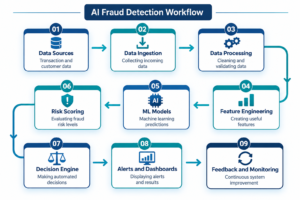
A reliable fraud detection platform generally follows a layered architecture. Each layer performs a specific function, from collecting financial data to generating decisions and recording outcomes.
Data Ingestion Layer
The first layer collects information from different financial systems, including:
- Banking and payment APIs.
- Card processing platforms.
- Digital banking applications.
- Customer account databases.
- KYC and identity verification systems.
- Device intelligence providers.
Transaction events can be processed through streaming infrastructure or APIs, depending on transaction volume and latency requirements.
Data Processing and Feature Engineering
Raw data needs to be cleaned, validated, and converted into meaningful features before reaching machine learning models.
For example, instead of evaluating only a transaction amount, the system may calculate:
- Number of transactions in the previous five minutes.
- Average transaction value over the last 30 days.
- Time since the last successful login.
- Number of recent beneficiary changes.
- Difference between current and historical device behaviour.
These features help models understand the context surrounding a transaction.
Machine Learning and Risk Analysis Layer
This layer contains the models responsible for identifying potential fraud.
Different approaches can be combined:
| Technology | Purpose |
|---|---|
| Logistic Regression | Establishes an interpretable fraud prediction baseline |
| Random Forest | Identifies relationships across transaction features |
| XGBoost | Supports structured transaction risk classification |
| Isolation Forest | Detects unusual transaction patterns |
| Neural Networks | Models complex relationships in suitable datasets |
| Graph Analytics | Identifies suspicious connections between accounts and devices |
The selection depends on available data, fraud patterns, processing requirements, and the need for explainability.
Decision Engine
The decision engine combines model outputs with predefined business rules and risk policies.
For example:
- Low risk: Approve the transaction.
- Medium risk: Request additional authentication.
- High risk: Hold the transaction or send it for investigation.
This separation between prediction and decision-making is important. A machine learning model estimates risk, while the decision engine applies the financial institution’s approved policies.
Dashboard and Reporting Layer
Fraud analysts need a central dashboard to review suspicious transactions, investigate cases, monitor model performance, and identify recurring fraud patterns.
Useful dashboard components include transaction summaries, risk distribution, alert trends, investigation status, false-positive analysis, and model performance reports.
Feedback and Model Monitoring Layer
Once a transaction has been investigated, its outcome can provide valuable feedback.
Confirmed fraud cases and legitimate transactions can be used to improve future model training, subject to appropriate data quality and governance checks.
The system should also monitor changes in transaction patterns, model drift, missing data, processing delays, and unusual alert volumes.
Simplified architecture flow:
Technologies Used to Build AI-Based Fraud Detection Systems
The technology stack depends on the product’s scale, existing infrastructure, and security requirements.
| Technology | Common Use |
|---|---|
| Python | Data processing and machine learning development |
| TensorFlow / PyTorch | Deep learning model development |
| Scikit-learn | Traditional machine learning and anomaly detection |
| XGBoost | Structured fraud classification |
| Apache Kafka | Real-time event streaming |
| Apache Spark | Large-scale data processing |
| PostgreSQL | Transaction and application data |
| Redis | Low-latency feature and cache access |
| FastAPI | Model-serving and backend APIs |
| AWS / Azure / Google Cloud | Cloud infrastructure and deployment |
| Docker / Kubernetes | Application packaging and scaling |
Not every project requires all these technologies. A focused MVP may use a simpler architecture, while a large banking platform may require distributed processing, dedicated model-serving infrastructure, and extensive integration capabilities.
How Much Does It Cost to Develop AI Fraud Detection Software in 2027?
The development cost depends on the type of fraud being addressed, data availability, transaction volume, model complexity, infrastructure, and integration requirements.
There is no universal price for developing this software. A payment fraud detection MVP and a large banking fraud monitoring platform involve very different engineering efforts.
The following figures are indicative planning estimates in USD, not fixed market prices or vendor quotations.
| Development Level | Estimated Cost | Typical Scope |
|---|---|---|
| Basic MVP | 25,000–50,000 | Core transaction monitoring, basic ML model, risk scoring, and dashboard |
| Mid-Level Platform | 50,000–120,000 | Multiple detection models, real-time processing, API integrations, and case management |
| Advanced Banking Platform | 120,000–250,000+ | Advanced analytics, distributed architecture, extensive integrations, governance, and monitoring |
Actual costs can fall outside these ranges depending on project requirements and delivery location.
Factors That Affect Development Cost
- Data availability and quality
Historical transaction data, confirmed fraud labels, customer behaviour records, and device information influence model development.
If the data is incomplete or inconsistent, additional data engineering and preparation will increase the project budget.
- Machine learning complexity
A basic classification model requires less engineering effort than a platform combining supervised learning, anomaly detection, graph analytics, and behavioural models.
- Third-party integrations
Connecting banking APIs, payment gateways, KYC providers, identity verification services, and external risk intelligence platforms adds development and testing requirements.
- Security and compliance requirements
Financial software requires appropriate encryption, access control, audit logs, data retention policies, and secure integration practices. The exact requirements depend on the institution and its regulatory obligations.
- Scalability and transaction volume
A system handling a few thousand daily transactions has different infrastructure requirements from one processing millions of events.
- Ongoing maintenance
Model monitoring, cloud infrastructure, security updates, performance optimisation, and periodic retraining contribute to long-term operational costs.
Development Timeline
| Development Stage | Indicative Timeline |
|---|---|
| Requirements and feasibility | 1–2 weeks |
| Data preparation and architecture | 2–4 weeks |
| Model development | 3–5 weeks |
| Backend and dashboard development | 3–5 weeks |
| Integrations and testing | 2–4 weeks |
| Deployment and initial monitoring | 1–2 weeks |
These activities may overlap. A focused MVP could take approximately 10–16 weeks, while a complex banking platform may require several additional months.
How Can Businesses Control Development Costs?
Businesses can avoid unnecessary spending by starting with a clearly defined fraud use case.
For example, a fintech company experiencing account takeover issues does not necessarily need a complete banking fraud management platform in its first release.
A practical approach is to:
- Select one high-priority fraud scenario.
- Evaluate existing data before selecting models.
- Build an MVP with essential detection features.
- Integrate only the systems required for the first release.
- Test model performance using historical and future-period data.
- Expand functionality based on actual results.
This approach helps validate technical feasibility before committing to a larger development budget.
Security, Compliance and Responsible AI Considerations for US Financial Businesses
Fraud detection platforms handle sensitive financial and customer information. Security and governance must therefore be considered during architecture planning, not added after development.
For US financial institutions, relevant considerations may include:
- GLBA: Protecting customer financial information through appropriate privacy and security practices.
- PCI DSS: Applying relevant payment card data security requirements when cardholder data is handled.
- BSA/AML: Supporting applicable transaction monitoring, suspicious activity investigation, and reporting workflows.
- Data privacy: Managing sensitive information, access permissions, retention, and secure data transfers.
- Model governance: Documenting model assumptions, testing, validation, limitations, and ongoing performance.
An important development in 2026 is the revised interagency model risk management guidance issued by the Federal Reserve, FDIC, and OCC on April 17, 2026, through SR 26-2. It replaces the earlier SR 11-7 guidance and emphasises a risk-based approach tailored to an institution’s size, complexity, and model usage.
The guidance highlights model development, validation, monitoring, governance, and controls. Its applicability should be assessed based on the institution’s circumstances.
The NIST AI Risk Management Framework also provides a useful voluntary reference for managing AI risks across system design, development, deployment, and evaluation.
Compliance obligations vary by business model and institution. Software developers can implement technical controls and support compliance-ready engineering, but regulatory interpretation and approval should be reviewed by qualified legal and compliance professionals.
How to Choose an AI Fraud Detection Software Development Company
Selecting a development partner is an important decision because financial fraud detection involves sensitive data, complex integrations, and ongoing model management.
When evaluating AI fraud detection companies, consider the following:
- AI and machine learning expertise: Check whether the team understands classification, anomaly detection, feature engineering, model evaluation, and deployment.
- Financial software experience: Look for experience with payment systems, digital banking, lending workflows, KYC, and financial APIs.
- Security-first architecture: Evaluate how the company approaches encryption, authentication, access permissions, and audit trails.
- Integration capabilities: Confirm that the development team can connect the solution with existing banking platforms and third-party services.
- Scalability: Discuss how the architecture will handle growing transaction volumes and future features.
- Post-launch support: Model monitoring, maintenance, and performance improvements should be part of the long-term plan.
Businesses comparing fraud detection software companies in USA should also evaluate delivery models, communication, technical ownership, documentation, and total project costs rather than relying only on initial quotations.
Building a Custom AI Fraud Detection Solution: What Should Businesses Do First?
Before starting development, businesses should define the problem they want to solve and identify the information required to address it.
A structured development process generally includes:
Step 1: Business and fraud assessment
Identify the most common fraud scenarios, financial exposure, customer impact, and existing detection limitations.
Step 2: Data assessment
Review historical transactions, fraud labels, customer records, and available integrations to determine whether the required data is sufficient.
Step 3: Architecture and model selection
Choose suitable machine learning approaches, processing infrastructure, APIs, and deployment architecture.
Step 4: Development and testing
Build the backend, AI models, decision engine, dashboards, and required integrations. Evaluate model performance using appropriate test datasets.
Step 5: Controlled deployment
Begin with shadow monitoring or a limited rollout, review alerts, and validate the system before enabling automated high-impact decisions.
Step 6: Continuous improvement
Monitor model performance, investigate false positives, update risk policies, and retrain models when justified by new data.
A well-planned project should also define measurable success criteria, such as fraud loss reduction, detection recall, false-positive rate, transaction approval rate, investigation workload, and decision latency.
Final Thoughts: Preparing Financial Platforms for Smarter Fraud Prevention
Financial fraud is not limited to one payment method or a single attack pattern. As digital financial services expand, businesses need systems that can analyse transactions in context, identify unusual behaviour, and support timely decisions.
A successful solution combines machine learning, real-time data processing, risk scoring, explainability, secure integrations, and continuous monitoring. The right development approach depends on the business’s fraud exposure, available data, operational requirements, and long-term growth plans.
For companies planning a custom solution, starting with a focused use case and a scalable technical foundation is often more practical than building an unnecessarily complex platform from day one.
Planning an AI-based fraud detection platform for your financial business?
Whether you are planning a new fraud detection product or adding intelligent risk monitoring to an existing financial platform, talk to Trisha Global Tech to discuss your requirements and development approach.
Frequently Asked Questions
- How does AI detect fraudulent bank transactions?
Ans- AI analyses transaction history, customer behaviour, device information, payment frequency, and other risk indicators. Machine learning models identify unusual patterns and assign risk scores to transactions, helping banks decide whether to approve, challenge, or investigate them.
- What is the difference between traditional and AI-based fraud detection?
Ans- Traditional fraud detection relies mainly on predefined rules and thresholds. AI-based systems use machine learning to identify relationships across multiple data points, adapt to changing patterns, and detect suspicious activities that fixed rules may overlook.
- How much does it cost to develop AI fraud detection software?
Ans- A basic MVP may cost approximately 25,000–50,000, while a more advanced platform can cost 120,000–250,000 or more. The final budget depends on model complexity, data availability, integrations, infrastructure, and security requirements.
- Which machine learning algorithms are used for fraud detection?
Ans- Common approaches include Logistic Regression, Random Forest, XGBoost, Isolation Forest, and neural networks. The appropriate algorithm depends on the fraud type, available training data, processing requirements, and explainability needs.
- Can AI detect banking fraud in real time?
Ans- Yes. Real-time fraud detection systems process incoming transaction events, evaluate relevant risk indicators, and generate decisions within the transaction workflow. Processing speed depends on infrastructure, integrations, and model complexity.
- What features should fraud detection software for banks include?
Ans- Important features include real-time transaction monitoring, machine learning-based risk scoring, anomaly detection, behavioural analytics, automated alerts, case management, explainable decisions, audit trails, and performance monitoring.
- How long does it take to build a custom AI fraud detection system?
Ans- A focused MVP may take approximately 10–16 weeks, depending on data readiness and feature requirements. A larger banking platform with multiple integrations, advanced analytics, and extensive testing may require several additional months.
- Can AI fraud detection reduce false-positive transactions?
Ans- Yes. Machine learning models can evaluate multiple customer and transaction signals to distinguish legitimate activity from suspicious behaviour. Proper model calibration, quality data, and suitable risk thresholds are important for reducing false positives.
- Is custom fraud detection software better than ready-made solutions?
Ans- It depends on business requirements. Ready-made solutions can offer faster implementation and existing fraud intelligence, while custom platforms provide greater control over data, detection logic, integrations, and business-specific workflows. Some businesses benefit from combining both approaches.
- What should businesses consider when choosing an AI fraud detection development company?
Ans- Businesses should evaluate machine learning expertise, financial software experience, data security practices, banking API integration capabilities, model validation processes, scalability, and post-launch maintenance support.