
Introduction: Why AI Is Changing Travel & Hospitality Booking
Travelers today expect more than a simple search box when booking a flight, hotel, or holiday. They want quick answers, relevant recommendations, flexible options, and a booking experience that understands what they actually need. Traditional travel apps often make users search through dozens of hotels, compare prices, read reviews, and build their own itinerary. This process can be time-consuming, especially when travelers are unsure about what to choose.
AI is changing this experience by making travel booking more personalized and interactive. Instead of simply matching users with a list of available options, an AI-powered booking app can understand user preferences, analyze travel data, recommend suitable hotels or activities, answer questions, and even help create an itinerary. For example, a traveler could ask for a three-day family trip within a specific budget and receive relevant hotel, activity, and transportation suggestions in one place.
For travel agencies, hotels, OTAs, and hospitality businesses, this shift creates a significant business opportunity. Personalized recommendations can help customers make decisions faster, while AI-powered assistance can improve engagement throughout the booking journey. Businesses can also use AI to provide relevant upgrades, add-on services, and offers based on customer preferences, potentially increasing booking value and customer loyalty.
This is where Travel & Hospitality App Development is moving beyond traditional booking functionality. Modern apps need to combine reliable booking systems and third-party integrations with AI-driven personalization, automation, and conversational experiences. Businesses that build these capabilities into their apps can create smoother customer journeys while staying competitive in an increasingly digital travel market.
The key, however, is not simply adding an AI chatbot to a travel app. A successful AI booking platform needs the right combination of AI capabilities, real-time travel data, secure payments, booking integrations, intuitive UX, and scalable technology. The following sections explore how businesses can build an AI-powered travel and hospitality booking app and what it takes to turn the idea into a practical, revenue-generating product.
What Is an AI Booking App for Travel & Hospitality?
An AI booking app for travel and hospitality is a mobile or web application that uses artificial intelligence to help travelers search, compare, personalize, and book travel services. Instead of making users manually browse through hundreds of flights, hotels, activities, or packages, the app can understand what they are looking for and recommend options that better match their needs.
For example, a traveler might type, “Find me a family-friendly hotel in Goa for three nights under ₹15,000, close to the beach.” An AI-powered app can understand the destination, dates, budget, and preferences behind the request. It can then use connected travel data and booking systems to find suitable options and present relevant recommendations.
How Does an AI Booking App Work?
An AI booking app connects several important parts of the travel booking journey. It first understands the user’s search intent, such as where they want to travel, their budget, dates, preferred hotel type, or activities they are interested in.
The AI can then combine this information with the traveler’s preferences and past interactions. If a user frequently chooses boutique hotels, prefers certain room types, or usually travels with family, the app can use these signals to make more relevant recommendations.
Next, the application connects with real-time inventory and booking systems through APIs. This allows it to access information such as hotel availability, room rates, flights, activities, and other travel services. Based on the available options and user requirements, the AI can rank or recommend the most suitable choices.
Once the traveler selects an option, the app can take them through the booking and payment process and provide confirmation, updates, and additional assistance.
AI Booking App vs. Traditional Booking Platform
A conventional booking platform mainly works around filters and predefined search options. Users enter their destination, dates, budget, and other filters, then manually compare the available results.
An AI booking app can make this process more conversational and personalized. It can understand natural-language requests, learn from user preferences, recommend relevant options, answer follow-up questions, and support travelers throughout the booking journey.
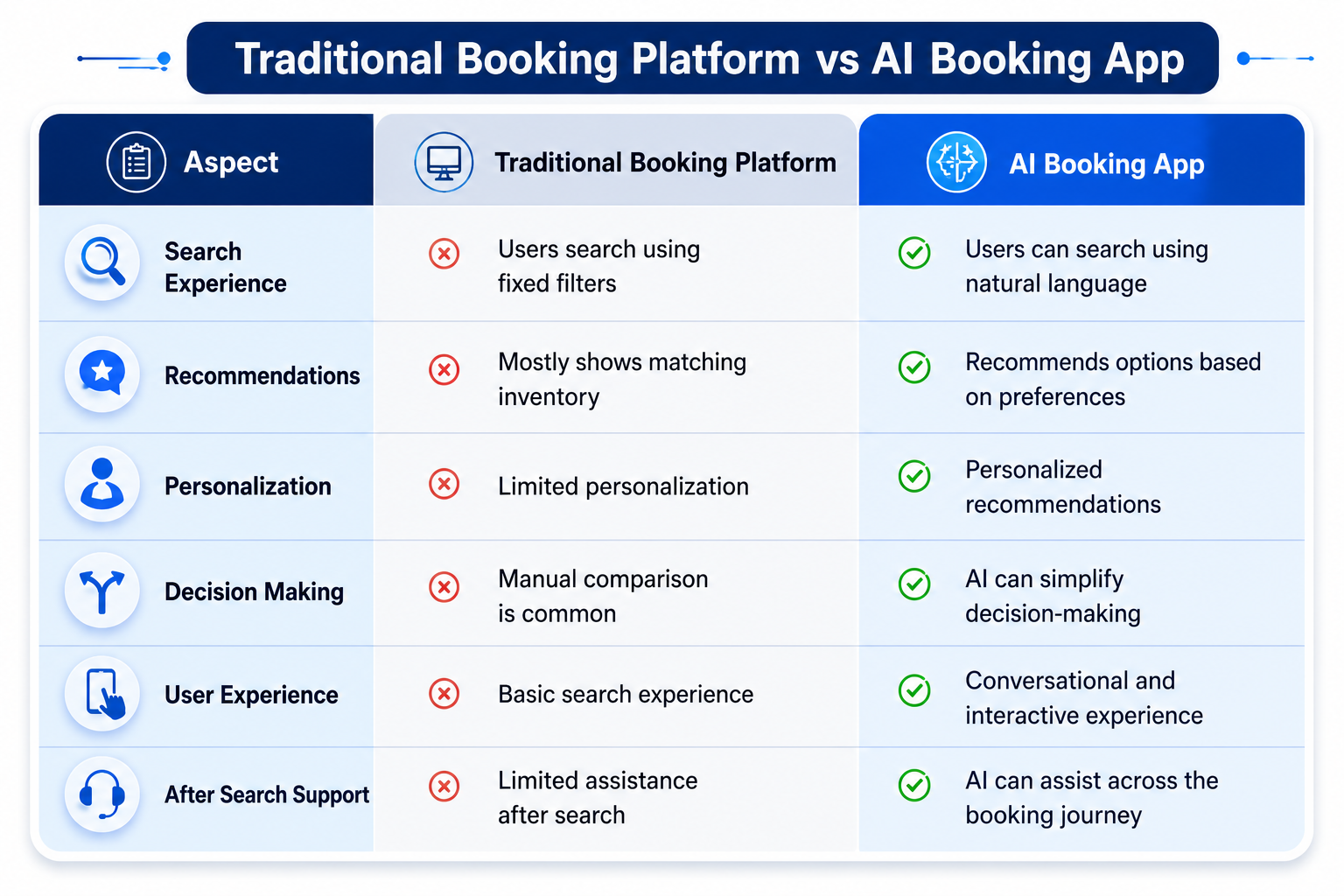
The goal of an AI booking app is not to replace the booking engine. Instead, AI works on top of the booking infrastructure to make search, discovery, decision-making, and booking more intelligent and convenient.
For businesses investing in Travel & Hospitality App Development, this approach can create a more personalized customer experience while opening opportunities to improve conversions, upsell relevant services, and build stronger long-term customer relationships.
How AI Booking Apps Work: From User Intent to Reservation
An AI travel booking app works by connecting the traveler’s request with AI models, real-time travel data, booking systems, and payment services. Instead of relying only on traditional filters, the app can understand what the user wants, identify suitable options, and guide them through the booking process.
Here is how the journey typically works:
User Query → AI Understanding → Recommendations → Availability → Pricing → Booking → Confirmation
1. User Enters a Travel Request
The process begins when a traveler searches for something they need. This could be a simple request such as “hotels in Dubai,” or a more detailed request like “Find a luxury hotel in Dubai for two people under $300 per night, close to the city center.”
An AI booking app can understand both simple and conversational requests, giving users a more natural way to search for travel services.
2. AI Understands the User’s Intent
The AI model analyzes the request to identify important details such as destination, travel dates, number of travelers, budget, accommodation preferences, and other requirements.
It can also consider information from previous searches, bookings, saved preferences, and interactions when personalization is enabled. This helps the app understand not only what the traveler searched for, but also what type of travel experience they are looking for.
3. AI Generates Relevant Recommendations
Once the user’s intent is understood, the AI can help rank and recommend relevant travel options. Instead of showing a long list of results, the application can prioritize options that closely match the user’s requirements.
For example, a traveler looking for a quiet family hotel may receive recommendations based on location, room type, amenities, reviews, budget, and previous preferences.
4. APIs Fetch Real-Time Availability
The AI itself does not normally maintain all hotel, flight, or activity inventory. The application connects with travel APIs, GDS platforms, hotel systems, PMS platforms, or other inventory providers to retrieve current information.
These APIs can provide details such as:
- Available rooms or seats
- Current rates
- Room and fare types
- Hotel and property information
- Cancellation policies
- Activities and additional services
This connection is important because travelers need accurate availability before completing a reservation.
5. The App Compares Pricing and Options
After receiving live inventory, the booking application can compare available options against the user’s requirements. The system can display prices, amenities, policies, locations, and other relevant information.
AI can then help explain the differences between options rather than simply presenting raw results. For example, it might identify which hotel offers better value based on the traveler’s budget and preferences.
6. Booking Engine Processes the Reservation
Once the traveler selects an option, the booking engine takes over the reservation process. It communicates with the relevant travel provider or inventory system to confirm the selected room, flight, activity, or package.
The application can then collect traveler details, process payment through a secure payment gateway, and complete the reservation.
7. Confirmation and Post-Booking Assistance
After a successful transaction, the user receives booking confirmation and relevant travel details through the app, email, or other supported channels.
The AI assistant can continue to support the traveler after booking by answering questions, suggesting activities, providing itinerary information, or helping with changes and other common requests.
How APIs, AI Models and Booking Engines Work Together
The key to an AI booking app is the coordination between different technology layers.
AI models understand user intent and help with personalization, recommendations, and conversational interactions. Travel APIs and integrations provide real-time inventory, availability, pricing, and service information. The booking engine manages the actual reservation workflow, while payment and authentication systems handle secure transactions and user access.
In simple terms:
AI understands what the traveler wants → APIs find what is available → AI helps recommend the best options → Booking engine completes the reservation → App confirms and supports the traveler.
This combination is what makes AI-powered Travel & Hospitality App Development different from simply adding a chatbot to an existing booking platform. The AI needs to work alongside reliable travel data and booking infrastructure to deliver a seamless experience from the first search to the final reservation.
AI Features That Make Travel Booking Apps More Competitive
Adding AI to a travel booking app is not just about offering a chatbot. The real advantage comes from using AI at different stages of the traveler’s journey, from discovering destinations to making a reservation and getting support afterward. The right AI features can reduce the time users spend searching, make recommendations more relevant, and create more opportunities for travel businesses to increase bookings and revenue.
1. AI-Powered Travel Recommendations
AI can analyze a traveler’s destination, budget, interests, previous searches, and booking behavior to recommend relevant hotels, flights, activities, or travel packages.
Instead of showing the same popular options to every user, the app can create recommendations based on individual preferences. This makes the discovery process faster and can help travelers find options they may otherwise overlook.
2. Personalized Hotel and Flight Suggestions
Personalization can make a major difference when travelers have too many options to compare. An AI-powered app can consider factors such as preferred airlines, hotel categories, price range, location, amenities, and previous bookings.
For example, if a traveler regularly chooses business hotels near city centers, the app can prioritize similar properties during future searches. This creates a more relevant experience without requiring the user to apply the same filters repeatedly.
3. AI Itinerary Generation
Travelers often need more than a hotel or flight. They also want to know what they can do after reaching their destination.
AI can generate personalized itineraries based on trip duration, interests, budget, travel companions, and preferred activities. A user could request a three-day family itinerary, for example, and receive suggestions for attractions, restaurants, activities, and suitable travel times.
The itinerary can also be updated when the traveler changes dates, activities, or preferences.
4. Conversational Search
Traditional booking searches require users to enter information into multiple filters. Conversational search allows them to describe what they want naturally.
A traveler could type:
“I need a beachfront hotel in Goa for a weekend trip with my family for under ₹20,000.”
The AI can identify the important requirements and convert them into a relevant search. Users can then ask follow-up questions without starting the search again, creating a smoother booking experience.
5. Dynamic Recommendations
Traveler preferences can change during the booking journey. AI can respond to these changes and update recommendations in real time.
For example, if a traveler initially searches for budget hotels but later selects a premium flight, the app may adjust hotel recommendations based on the updated travel profile. Similarly, recommendations can change based on availability, booking history, location, or user interactions.
This makes the experience more responsive than a static search-results page.
6. Smart Upselling and Cross-Selling
AI can also help travel businesses increase the value of each booking by recommending relevant additional services.
After a hotel reservation, the app might suggest airport transfers, breakfast, room upgrades, local experiences, travel insurance, or activities based on the customer’s trip.
The important point is relevance. Instead of displaying the same offers to every customer, AI can select add-ons that are more likely to be useful to a particular traveler.
7. AI Customer Support
Travelers may have questions before, during, and after a booking. An AI-powered support assistant can provide quick answers to common questions about reservations, cancellation policies, check-in times, baggage, hotel amenities, and travel services.
For more complex issues, the AI can collect the necessary information and transfer the conversation to a human support agent. This allows businesses to automate routine queries while keeping human assistance available when it matters.
8. Automated Booking Assistance
AI can guide users through the booking process instead of making them navigate multiple screens on their own.
For example, the assistant can help select a hotel, compare room options, explain cancellation policies, collect required details, and direct the traveler toward payment. With the appropriate booking integrations and user confirmation, the system can automate parts of the reservation workflow while keeping important actions transparent to the customer.
Why These AI Features Matter for Travel Businesses
The strongest AI booking apps do not use AI simply because it is a popular technology. They use it to solve specific problems in the customer journey.
When implemented correctly, AI can help travelers discover options faster, receive more relevant recommendations, simplify booking decisions, and get support when they need it. For travel companies, these capabilities can contribute to higher engagement, better conversion opportunities, stronger customer loyalty, and additional revenue through personalized services.
For businesses considering Travel & Hospitality App Development, the best approach is to prioritize AI features according to their target audience, booking model, available data, and business goals rather than trying to include every AI capability in the first version.
Key Integrations for an AI Travel & Hospitality App
An AI travel and hospitality app needs more than a smart interface or AI assistant to deliver a complete booking experience. It needs to connect with the systems that provide real-time inventory, pricing, payments, customer information, and location data.
These integrations allow the AI layer to work with accurate business data and help the app move smoothly from search and recommendations to booking and post-booking support.
1. Hotel and PMS Integrations
Hotel Property Management Systems (PMS) store important operational information such as room availability, reservations, guest details, room types, and rates.
Connecting the app with a PMS can help hotels keep their booking information synchronized across channels. When a room is booked or its availability changes, the app can receive updated information and reduce the risk of displaying outdated inventory.
For hotel-focused applications, PMS integration can also support better coordination between reservations, guest services, and hotel operations.
2. GDS and OTA Integrations
Global Distribution Systems (GDS) and Online Travel Agencies (OTA) can provide access to a broad range of travel inventory.
GDS integrations can be particularly useful for applications that need access to airline, hotel, car rental, or other travel-related inventory. OTA integrations can help businesses connect with external travel marketplaces where supported.
The right integration strategy depends on the business model, target market, inventory requirements, and partnerships available to the company.
3. Flight and Hotel APIs
Flight and hotel APIs allow an application to retrieve information such as availability, pricing, schedules, room details, booking rules, and other travel data.
For an AI booking app, these APIs are especially important because AI recommendations are only useful when they are connected to reliable and current inventory. The application can combine user preferences with available travel data to present relevant options.
A well-designed API layer can also make it easier to add new suppliers or travel services as the platform grows.
4. Payment Gateway Integration
A secure payment gateway is essential for completing online travel bookings. Depending on the target market, an application may need to support cards, digital wallets, bank-based payment methods, or other local payment options.
The payment architecture should also account for refunds, cancellations, failed transactions, transaction status updates, and secure handling of sensitive payment information.
A smooth payment experience is important because even a highly personalized booking journey can lose a customer if the final payment process is slow, confusing, or unreliable.
5. Maps and Location APIs
Location data plays an important role in travel planning. Maps and location APIs can help users find hotels, attractions, restaurants, airports, and other places around their destination.
These integrations can also support features such as distance calculations, nearby recommendations, route planning, location-based search, and interactive maps.
When combined with AI, location data can make recommendations more useful. For example, the app could suggest hotels close to a traveler’s preferred attractions rather than simply recommending highly rated properties.
6. CRM and Loyalty System Integration
CRM integration allows travel businesses to connect booking activity with customer profiles and interactions. This can help businesses understand customer preferences and provide more consistent experiences across different touchpoints.
Loyalty system integration can support points, rewards, membership tiers, personalized offers, and other retention programs.
When appropriate customer data is available, AI can use these signals to make recommendations and offers more relevant while helping businesses build long-term customer relationships.
Why Integration Architecture Matters for Scalability and Reliability
The number of integrations can increase quickly as a travel application grows. If every feature communicates directly with every external service, the system can become difficult to maintain and more vulnerable to failures.
A well-planned integration architecture creates a structured layer between the app and external providers. This can make it easier to manage APIs, monitor failures, switch providers, add new services, and handle changes without rebuilding the entire application.
For example, if one hotel supplier temporarily becomes unavailable, a flexible architecture can allow the platform to use another available source where the business model supports it. Similarly, caching, retries, monitoring, rate-limit management, and asynchronous processing can help improve system resilience.
This is particularly important for AI-powered booking platforms because the AI layer, booking engine, inventory providers, payment services, and customer systems all need to work together reliably.
For businesses investing in Travel & Hospitality App Development, integration architecture should therefore be considered from the beginning—not treated as a technical detail to solve after the app is built. A scalable integration foundation can make it easier to expand inventory, introduce new AI capabilities, enter new markets, and support growing booking volumes.
How to Build an AI Booking App: Development Process
Building an AI booking app requires more than adding an AI assistant to a traditional travel application. The platform needs to combine a simple user experience with AI capabilities, real-time travel data, booking infrastructure, secure payments, and reliable integrations.
A structured development process helps businesses validate the idea early, control development costs, and build a platform that can scale as bookings and users increase.
1. Start With Business and User Research
The first step is to understand the business model and the people who will use the app. A travel agency, hotel group, OTA, and corporate travel platform may have very different requirements.
Research should identify the target audience, booking journey, customer pain points, competitors, revenue model, required travel inventory, and opportunities where AI can provide genuine value.
For example, if customers spend too much time comparing hotels, personalized recommendations and conversational search may be more valuable than building complex AI itinerary features at the initial stage.
2. Plan the MVP
Instead of developing every possible feature at once, businesses can begin with a Minimum Viable Product (MVP) that focuses on the core booking experience.
An AI booking MVP may include:
- User registration and profiles
- Conversational or AI-assisted search
- Hotel or flight search
- Personalized recommendations
- Real-time availability
- Booking and payment
- Booking history
- Basic AI customer assistance
The exact MVP should depend on the business model and target audience. Starting with the most important features allows businesses to test demand and collect real user feedback before making larger investments.
3. Design the UX/UI
The interface should make AI feel useful without making the booking process complicated. Travelers should be able to search traditionally if they prefer, while conversational AI can provide an additional way to discover and compare options.
Design teams typically map the complete user journey from search to confirmation and create intuitive screens for recommendations, property or flight details, checkout, and post-booking support.
The goal is to reduce unnecessary steps and make important information—especially pricing, availability, cancellation rules, and booking details—easy to understand.
4. Design the AI and Recommendation Architecture
The next step is to determine where AI will be used and what data it needs.
Depending on the product, the AI architecture may support conversational search, recommendation systems, itinerary generation, personalization, customer support, or automated assistance.
The architecture should also define how AI interacts with live travel data. The AI should not simply generate suggestions without checking actual inventory. It needs a reliable way to access current availability, prices, booking rules, and other relevant information.
Data privacy, model selection, monitoring, response quality, and human escalation should also be considered during this stage.
5. Develop APIs and Third-Party Integrations
Travel applications often depend on multiple external systems for inventory and services. Developers integrate hotel, flight, PMS, GDS, OTA, payment, maps, CRM, and other APIs according to the application’s requirements.
A strong integration layer helps keep these connections organized and makes the platform easier to maintain. It should also account for API failures, rate limits, response times, authentication, data synchronization, and changes from external providers.
6. Develop the Booking Engine
The booking engine manages the core reservation workflow. It connects search results with availability checks, traveler information, pricing, payment, reservation creation, and confirmation.
For an AI-powered app, the booking engine needs to work closely with the AI layer without allowing AI-generated information to replace authoritative booking data.
Before confirming a reservation, the system should verify the latest availability, price, and booking conditions with the relevant provider.
7. Test Security, Performance, and Booking Reliability
Travel applications handle sensitive information and financial transactions, so testing needs to cover more than the visual interface.
Teams should test authentication, payment workflows, API security, data protection, booking accuracy, cancellation processes, error handling, and access controls.
Performance testing is also important. The platform should be able to handle increased traffic during peak travel periods without slowing down searches or creating booking failures.
AI responses should also be tested for accuracy, relevance, consistency, and inappropriate or misleading recommendations.
8. Deploy and Continuously Optimize
After testing, the application can be deployed to the required platforms and monitored in a real-world environment.
However, development does not end at launch. User behavior, search patterns, booking conversions, failed transactions, AI interactions, and customer feedback can reveal opportunities for improvement.
Businesses can use these insights to refine recommendations, improve the booking journey, introduce new integrations, optimize performance, and gradually expand AI capabilities.
Building for Long-Term Growth
A successful AI booking app should be planned with future growth in mind. Starting with a focused MVP does not mean creating a limited architecture that needs to be rebuilt later.
A scalable foundation allows businesses to add new travel services, AI capabilities, suppliers, markets, and customer segments as the platform grows.
For companies considering Travel & Hospitality App Development, this step-by-step approach can reduce unnecessary development costs while creating a clear path from an initial AI booking concept to a reliable, scalable travel platform.
AI Booking App Tech Stack and Architecture
The technology stack of an AI booking app should be selected according to the application’s business model, expected traffic, number of integrations, AI requirements, and future growth. There is no single technology stack that is best for every travel platform.
A small travel startup may need a lightweight architecture for its MVP, while a large OTA or hospitality group may require a distributed system capable of handling millions of searches, real-time inventory, multiple suppliers, and high booking volumes.
1. Frontend and Backend Choices
The frontend is responsible for the traveler’s experience, including search, AI conversations, recommendations, hotel or flight details, checkout, and booking management.
Depending on the product, businesses can choose technologies such as React, Next.js, Flutter, or React Native for web and mobile experiences.
The backend manages business logic, user accounts, bookings, payments, integrations, and communication with AI services. Technologies such as Node.js, Python, Java, or .NET can be suitable depending on the team’s expertise and platform requirements.
The right choice should be based on performance, development speed, maintainability, and the application’s expected scale—not simply on which technology is currently popular.
2. AI, ML and LLM Layer
The AI layer powers capabilities such as conversational search, travel recommendations, itinerary generation, personalization, and automated customer assistance.
An application may use large language models (LLMs) for understanding natural-language requests and generating responses, while machine learning or recommendation models can help rank hotels, flights, activities, and offers.
The AI architecture should also include mechanisms for connecting models with trusted travel data. This helps ensure that recommendations are based on current inventory and business rules rather than relying only on generated responses.
For cost and performance control, businesses may also use different models for different tasks instead of sending every request to the most powerful model.
3. Database Architecture
An AI travel platform can work with several types of data, including user profiles, bookings, hotel information, pricing, preferences, reviews, and interaction history.
A relational database can manage structured information such as users, reservations, payments, and transactions. Additional databases or caching systems may be introduced when the application needs to handle large amounts of search data, sessions, analytics, or AI-related information.
The database architecture should prioritize data consistency, security, backup, performance, and scalability, especially for booking and payment information where accuracy is critical.
4. Cloud Infrastructure
Cloud infrastructure provides the flexibility needed to scale an AI booking platform as traffic changes.
Cloud services can support application hosting, databases, storage, AI workloads, monitoring, security, content delivery, and automated deployment. The infrastructure can be designed to scale resources based on demand rather than maintaining expensive capacity that may remain unused.
This is particularly useful for travel applications because traffic can increase significantly during holidays, seasonal travel periods, major events, or promotional campaigns.
5. APIs and Microservices
Travel applications often need to communicate with multiple external services. APIs provide the connection between the application and systems such as hotel suppliers, flight providers, payment gateways, maps, PMS platforms, and CRM systems.
For larger platforms, a microservices architecture can separate important functions such as search, user management, pricing, booking, payments, notifications, and AI services.
However, microservices should not be adopted simply because they sound more scalable. For a smaller MVP, a well-structured modular backend may be easier and more cost-effective to manage. Microservices become more valuable when system complexity, team size, traffic, or independent scaling requirements justify them.
6. Real-Time Availability and Pricing
Real-time travel information is one of the most important technical requirements of a booking application.
Hotel rooms, flights, prices, and availability can change frequently. The platform therefore needs reliable connections with travel suppliers and should verify important information before a booking is finalized.
Caching can improve search performance, but cached information should be handled carefully because outdated pricing or availability can create poor customer experiences and failed bookings.
A strong architecture can combine caching, API calls, availability checks, retries, monitoring, and fallback mechanisms to provide a balance between speed and data accuracy.
How to Choose the Right Tech Stack for Your Scale
The best technology stack is not necessarily the one with the longest list of technologies. It is the one that solves the application’s current requirements while leaving enough room for future growth.
For example:
Early-stage MVP:
Focus on development speed, manageable infrastructure, essential integrations, and a simple architecture that can validate the business idea.
Growing travel platform:
Add stronger caching, monitoring, scalable databases, more integrations, improved AI infrastructure, and better performance management.
Large-scale booking platform:
Consider distributed services, advanced data infrastructure, automated scaling, multiple supplier connections, fault tolerance, sophisticated recommendation systems, and stronger observability.
This approach prevents businesses from overengineering an MVP while still avoiding architectural decisions that create problems at scale.
For companies investing in Travel & Hospitality App Development, technology selection should therefore start with business requirements and expected scale. The goal is to create an architecture that is secure, reliable, cost-efficient, and flexible enough to support increasing users, bookings, AI workloads, and travel integrations over time.
How Much Does Travel & Hospitality App Development Cost?
The cost of Travel & Hospitality App Development can vary significantly depending on the type of platform, number of integrations, AI capabilities, supported devices, and level of customization. There is no single development price that applies to every travel business.
A basic booking MVP with essential features will require a very different investment than a large AI-powered platform connected to multiple hotel, flight, payment, CRM, and travel inventory systems.
Instead of focusing only on a fixed price, businesses should evaluate the major factors that influence the overall development budget.
Key Factors That Affect AI Booking App Development Cost
Several components can increase or decrease the cost of an AI travel booking app.
- App Scope and Features
The number and complexity of features have a direct impact on development time. User accounts, search, hotel or flight booking, payments, reviews, loyalty programs, notifications, dashboards, and AI assistance all require different levels of development effort.
- AI Complexity
Basic conversational search is generally less complex than a platform with advanced personalization, AI itinerary generation, recommendation engines, automated customer support, and predictive capabilities.
The cost can also depend on whether the business uses existing AI models through APIs, custom machine learning models, or a combination of both.
- Third-Party Integrations
Travel applications often require integrations with hotel APIs, flight APIs, GDS platforms, PMS systems, payment gateways, maps, CRM platforms, loyalty systems, and other services.
Each integration can introduce additional development, testing, maintenance, authentication, and monitoring requirements.
- Platforms
Developing for a single platform can require less investment than supporting iOS, Android, and web applications separately.
Cross-platform development can sometimes reduce development effort, but the right approach depends on the application’s performance, UX, hardware, and business requirements.
- Security and Compliance
Travel applications handle personal information, booking details, and payment-related data. Security measures such as authentication, encryption, access controls, secure APIs, monitoring, and appropriate compliance requirements need to be included in the project budget.
- Maintenance and Infrastructure
Development costs do not end when the app is launched. AI model usage, cloud infrastructure, API subscriptions, bug fixes, security updates, performance optimization, and new feature development can create ongoing costs.
MVP vs. Advanced AI Booking Platform
A useful way to estimate the budget is to separate an initial MVP from a more advanced platform.
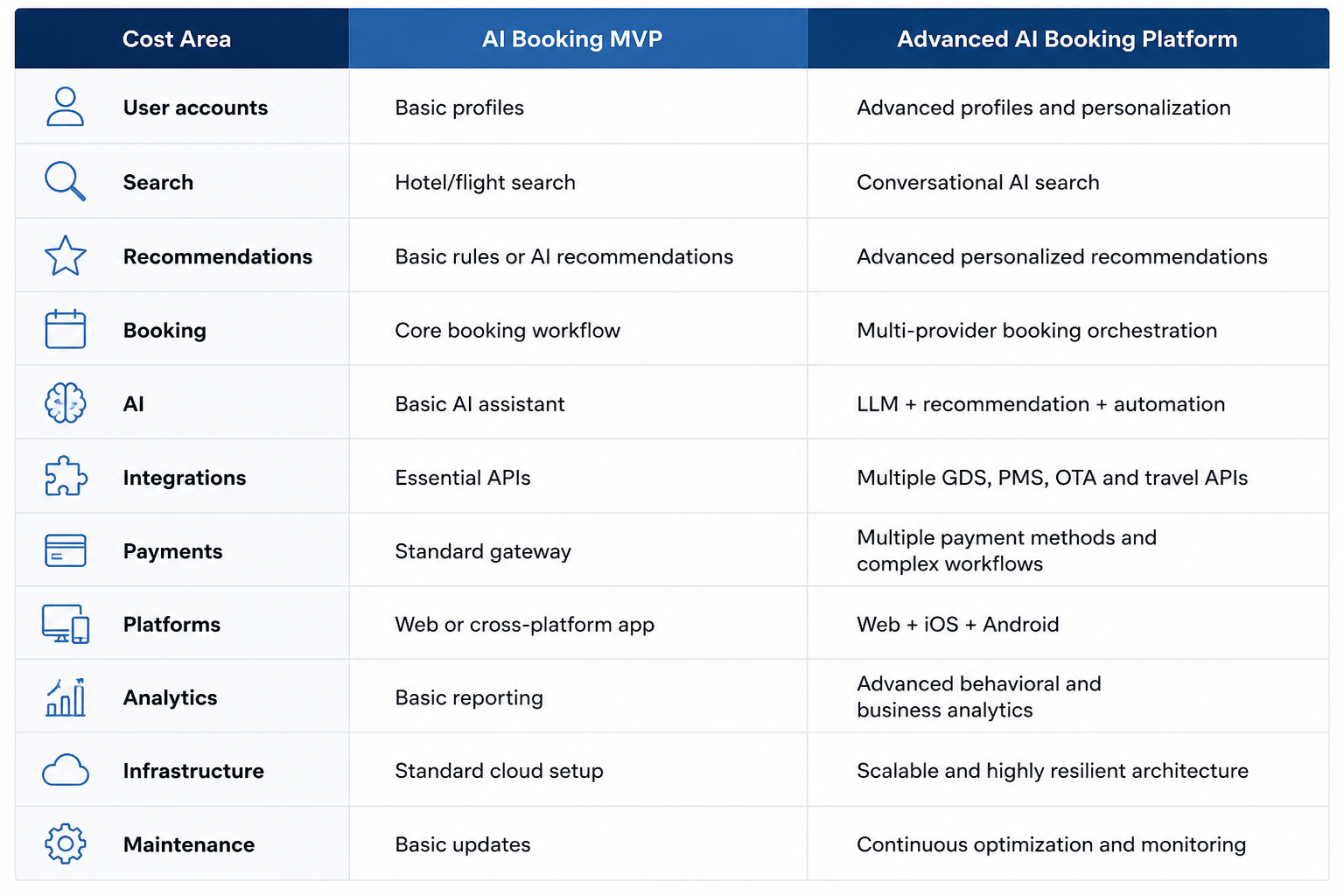
An MVP is generally the better starting point for a new travel product because it allows the business to validate demand, test the booking experience, and understand customer behavior before investing heavily in advanced capabilities.
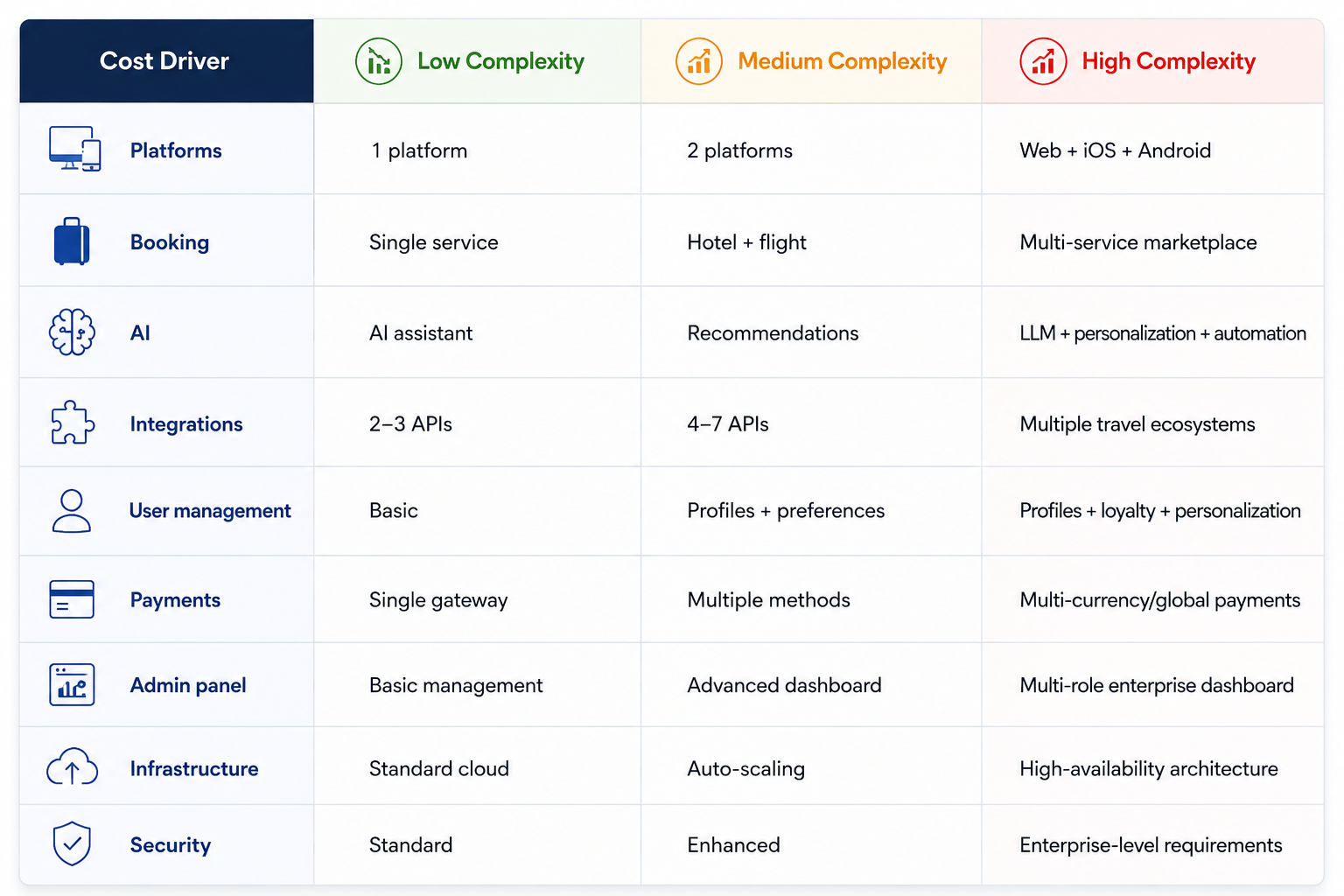
A Practical Cost-Estimation Framework
Rather than providing an arbitrary single figure, businesses can estimate the project by scoring the complexity of each major component.
What Should Be Included in a Development Estimate?
A professional development estimate should clearly separate the major project components, including:
- Discovery and business analysis
- UX/UI design
- Mobile and web development
- Backend and booking engine
- AI development and integration
- Third-party API integrations
- Payment integration
- Testing and security
- Cloud deployment
- Project management
- Post-launch maintenance
This makes it easier to understand where the investment is going and identify areas that can be reduced or expanded.
How to Reduce Development Costs Without Sacrificing Quality
Businesses can control initial costs by launching with a focused MVP instead of developing every possible feature from day one. Essential booking functionality, a limited number of integrations, and one or two high-value AI capabilities can provide a strong starting point.
The architecture should still be designed with future expansion in mind. This allows additional AI features, travel suppliers, payment methods, platforms, and loyalty capabilities to be added as the business grows.
Final Takeaway
The cost of building an AI travel booking app depends more on what the platform needs to accomplish than on the word “AI” itself. Features, integrations, AI complexity, platforms, security, infrastructure, and long-term maintenance all contribute to the final investment.
For an accurate estimate, businesses should first define their target users, booking model, required integrations, AI capabilities, platforms, and expected scale. A development partner can then convert these requirements into a detailed scope, timeline, technology plan, and project estimate.
Planning an AI-powered travel or hospitality platform? A development consultation can help you identify the right MVP scope, estimate development effort, and determine which AI features are worth investing in first.
How AI Booking Apps Increase Revenue and Customer Loyalty
An AI booking app can do more than make travel search easier. When AI is connected to booking data, customer preferences, inventory, and marketing systems, it can help travel and hospitality businesses improve the customer journey while creating new opportunities to increase revenue.
The biggest advantage comes from using AI at the right points in the booking journey rather than treating it as a standalone chatbot.
Higher Booking Conversions
Travelers often abandon bookings because they find too many options, cannot quickly compare them, or are unsure which option is best for their needs.
AI can reduce this decision-making effort by understanding the traveler’s requirements and highlighting relevant hotels, flights, packages, or activities. Personalized recommendations can help users reach a booking decision faster.
For example, instead of showing 500 hotels, an AI booking app could identify the options that best match the user’s budget, location preferences, amenities, and previous behavior.
A smoother and more relevant booking experience can create more opportunities for businesses to convert searches into completed reservations.
Personalized Upselling and Cross-Selling
AI can also help businesses increase the value of each booking by recommending relevant additional services.
After a customer books a hotel, the app could suggest:
- Airport transfers
- Room upgrades
- Breakfast packages
- Local activities
- Travel insurance
- Car rentals
- Premium services
- Destination experiences
The important factor is personalization. An AI system can use information such as trip type, destination, booking value, preferences, and previous behavior to determine which offers are most relevant.
Instead of showing the same upgrade to every traveler, businesses can present offers that are more closely connected to the customer’s actual trip.
Direct-Booking Growth
Hotels and hospitality businesses often want to increase direct bookings because relying heavily on third-party booking channels can make it harder to build direct customer relationships.
An AI-powered website or mobile app can create a more personalized direct-booking experience by remembering preferences, answering questions, recommending suitable rooms, and offering relevant packages.
For returning customers, the app can make the process even easier by presenting personalized recommendations and saved information, reducing the effort required to make another reservation.
Reduced Customer Support Costs
Travelers can have questions at every stage of their journey. Many of these questions are repetitive, such as:
- What is the cancellation policy?
- What time is check-in?
- Can I change my booking?
- Is breakfast included?
- How can I find my reservation?
- What documents do I need?
An AI support assistant can handle many routine questions instantly. When an issue requires human involvement, the system can transfer the conversation to a support representative along with relevant booking information.
This can reduce the workload on customer support teams while allowing employees to focus on more complex issues.
More Repeat Bookings
A good AI booking experience does not have to end after the reservation is confirmed. The application can remember relevant customer preferences and use them to make future searches easier. Similar personalization strategies are also becoming valuable in E-Commerce & Retail App Development, where apps use customer behavior and purchase history to create more relevant experiences.
For example, if a traveler regularly books business hotels with specific amenities, the app can prioritize similar properties during their next trip. AI can also suggest destinations, hotels, or experiences based on previous trips without requiring customers to start their search from scratch.
This type of personalization makes the application more useful over time, strengthens customer relationships, and creates more opportunities for repeat bookings across digital platforms.
Better Customer Retention
Customer retention is closely connected to the overall experience. Fast support, relevant recommendations, simple booking, personalized offers, and useful post-booking assistance can make customers more likely to return.
Businesses can also combine AI with loyalty programs to provide more targeted rewards. For example, frequent travelers could receive personalized offers based on their booking patterns rather than generic promotions sent to every customer.
The result is a booking platform that becomes more useful as the customer interacts with it.
Practical ROI Example for an AI Booking App
Consider a hypothetical travel business that receives 50,000 qualified booking searches per month.
Suppose its current booking conversion rate is 2%, with an average booking value of $300.
Current monthly bookings:
50,000 × 2% = 1,000 bookings
Current monthly booking revenue:
1,000 × $300 = $300,000
Now assume that improvements from AI-powered search and personalized recommendations increase the conversion rate from 2% to 2.5%.
New monthly bookings:
50,000 × 2.5% = 1,250 bookings
New monthly booking revenue:
1,250 × $300 = $375,000
That represents an additional 250 bookings and $75,000 in monthly booking value, assuming the average booking value remains unchanged.
If the business also increases the average booking value by 10% through relevant upselling and cross-selling:
New average booking value:
$300 × 1.10 = $330
Potential monthly booking value:
1,250 × $330 = $412,500
Compared with the original $300,000, the difference is $112,500 in additional monthly booking value.
This is only an illustrative example, not a guaranteed result. Actual ROI will depend on factors such as conversion rates, margins, traffic quality, AI costs, average booking value, customer retention, and implementation costs.
Why ROI Should Be Measured Beyond Bookings
For an AI booking app, businesses should track more than the number of reservations. Useful metrics can include:
- Booking conversion rate
- Average booking value
- Revenue per user
- Upsell and cross-sell revenue
- Direct booking percentage
- Customer acquisition cost
- Repeat booking rate
- Customer support cost per booking
- Booking abandonment rate
- Customer lifetime value
These metrics help businesses understand whether AI is creating measurable commercial value rather than simply adding another technology feature.
For companies investing in Travel & Hospitality App Development, the strongest AI strategy is therefore one that connects technology directly to business outcomes. The goal should be to make booking easier for customers while helping the business increase conversions, generate additional revenue, reduce operational costs, and build stronger long-term customer relationships.
Building Smarter Travel Experiences With Trisha Global Tech
Building a successful AI-powered travel booking app requires a clear understanding of both technology and traveler expectations. Trisha Global Tech focuses on creating digital travel solutions that bring AI, booking technology, integrations, and user experience together in one scalable platform. From conversational search and personalized recommendations to real-time availability, secure payments, and automated assistance, each capability should serve a practical business or customer need.
The right architecture also makes it easier to connect hotel, flight, PMS, GDS, payment, CRM, and other travel APIs as the platform grows. By combining thoughtful product planning with scalable development practices, businesses can create booking experiences that are faster, more personalized, and easier to manage while preparing their platforms for future AI and travel technology advancements.
Conclusion: Build a Scalable AI Booking App With the Right Partner
AI is changing how travelers search, compare, and book hotels, flights, activities, and complete travel experiences. For travel agencies, hotels, OTAs, and hospitality businesses, an AI-powered booking app can create a more personalized customer journey while opening new opportunities to improve conversions, increase booking value, reduce support costs, and encourage repeat bookings.
However, building a successful AI booking app involves much more than adding a chatbot to an existing application. The AI needs to work alongside reliable booking infrastructure, real-time travel APIs, secure payment systems, personalization capabilities, and scalable cloud architecture.
The technology also needs to support the business as it grows. A well-planned platform should make it possible to add new travel suppliers, AI capabilities, payment methods, customer segments, and services without rebuilding the entire application.
This is why choosing the right Travel & Hospitality App Development partner is an important part of the project. An experienced development team can help turn the business idea into a practical product by defining the right MVP, selecting suitable technologies, designing the AI architecture, integrating travel APIs, and building a secure and scalable booking platform.
Ready to Build Your AI Booking App?
If you have an idea for an AI-powered travel or hospitality platform, start by evaluating the business model, AI opportunities, required integrations, technical architecture, and expected development investment.
Request an AI booking app consultation or architecture assessment to discuss your requirements, identify the right MVP features, and get a development roadmap tailored to your business goals.
Ready to turn your travel app idea into a scalable AI booking platform? Get in touch with our development team to discuss your project and request a customized development estimate.
FAQ:
Q 1: What is an AI travel booking app?
Ans: An AI travel booking app uses AI to understand traveler needs, personalize recommendations, simplify searches, automate bookings, and improve guest experiences.
Q 2: How does an AI travel booking app work?
Ans: It understands user intent, connects with travel APIs, checks real-time availability and pricing, recommends options, and supports secure booking.
Q 3: What AI features should a travel booking app have?
Ans: Key features include conversational search, personalized recommendations, AI itineraries, smart upselling, automated booking, and AI customer support.
Q 4: How much does AI travel app development cost?
Ans: Costs depend on features, AI complexity, integrations, platforms, security, and scale. An MVP costs less than a full AI booking platform.
Q 5: How long does it take to build an AI booking app?
Ans: Development time depends on scope, integrations, AI features, platforms, and testing. A focused MVP takes less time than an enterprise platform.
Q 6: Which APIs are needed for an AI travel booking app?
Ans: Common integrations include hotel, flight, GDS, OTA, PMS, payment, maps, CRM, and loyalty APIs based on the platform’s requirements.
Q 7: Can AI increase travel booking conversions?
Ans: Yes. AI can personalize search results, reduce decision time, recommend relevant options, and simplify booking to create more conversion opportunities.
Q 8: Can AI help hotels increase direct bookings?
Ans: Yes. AI can personalize hotel discovery, recommend rooms and packages, answer questions, and create a smoother direct-booking experience for guests.
Q 9: How can AI reduce travel customer support costs?
Ans: AI assistants can handle routine questions about bookings, policies, check-in, cancellations, and travel details while escalating complex issues to agents.
Q 10: How do I choose an AI travel app development company?
Ans: Evaluate travel API expertise, AI capabilities, booking experience, security, scalability, portfolio, development process, and post-launch support.