
Introduction:
Retail has evolved far beyond physical stores and basic online shopping. Today, businesses use software to manage inventory, process orders, engage customers, handle payments, track sales, and streamline day-to-day operations. As retail businesses grow, many turn to custom solutions that are built around their specific processes rather than trying to fit their needs into a standard platform.
So, how much does custom retail software development cost in 2026?
There is no one-size-fits-all answer because the overall development cost depends largely on what you want to include in your retail software platform or solution. The features, level of customization, number of users, integrations, supported platforms, security requirements, and overall complexity can all influence the final investment.
For a general estimate, Custom Retail Software Development can cost around $20,000 to $250,000+, depending on the scope of the project. A solution with essential retail functions will typically require a smaller investment, while a more comprehensive platform with advanced features, multiple integrations, automation, analytics, and support for complex business operations can require a much larger budget.
The best way to determine the actual cost is to first define your business requirements and decide which features and capabilities your platform needs. Once the scope is clear, a development team can provide a more accurate estimate based on the functionality, technology, integrations, and development effort involved.
Custom Retail Software Development Cost in 2026
For most businesses, a realistic development budget can be divided into three broad categories:
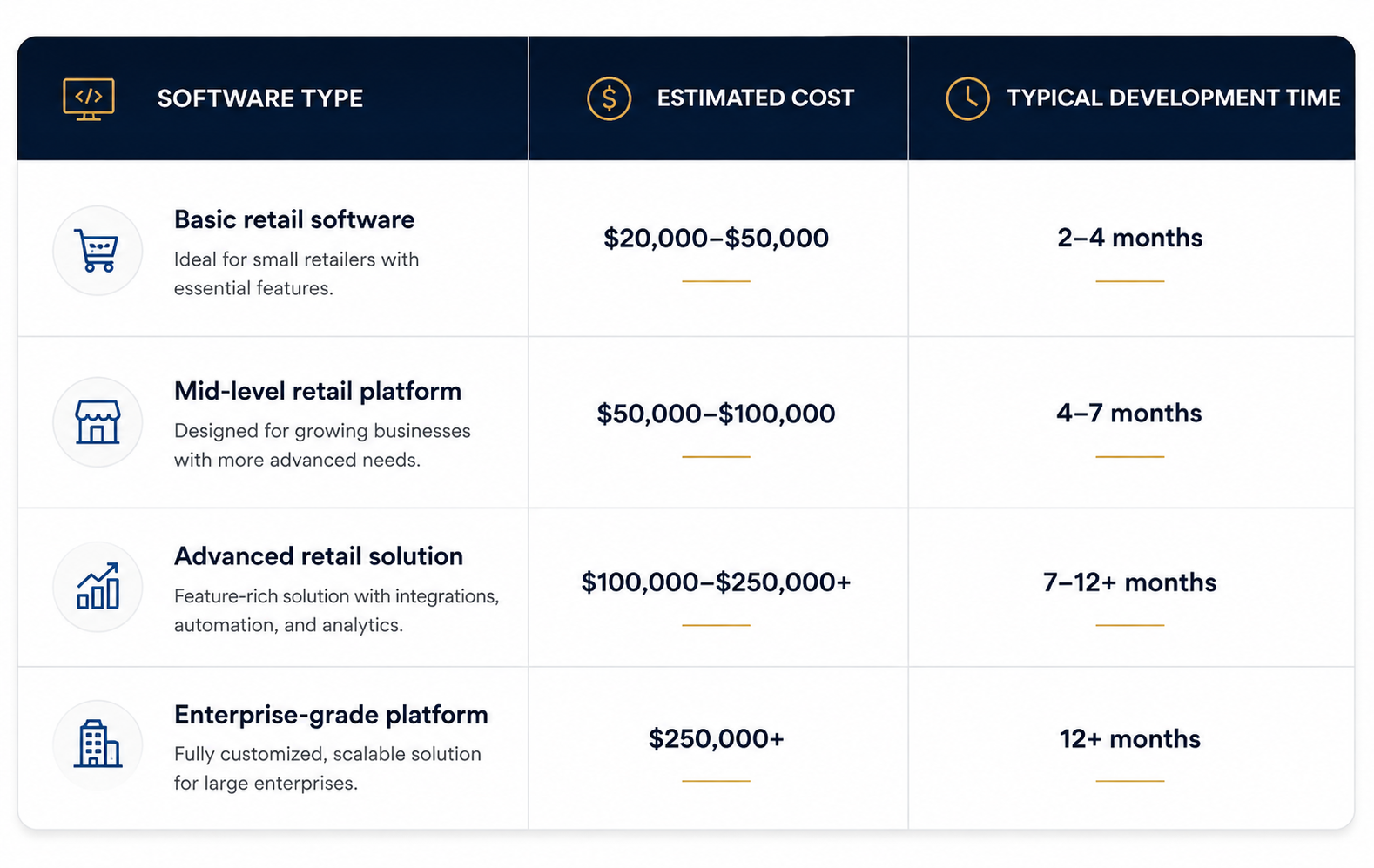
These figures are general estimates rather than fixed quotations. A small retailer building an internal inventory and billing system will have very different requirements from a large chain creating an omnichannel platform connected to warehouses, marketplaces, payment providers, and customer loyalty systems.
What Makes Custom Retail Software Expensive?
The biggest cost driver is usually scope. The more business processes the application needs to handle, the more planning, development, testing, and integration work is required.
For example, a straightforward system for managing products, stock, and sales may be relatively affordable. Adding real-time inventory synchronization, customer accounts, loyalty programs, recommendation features, advanced reporting, multiple store locations, and third-party integrations can significantly increase the budget.
Another important factor is the number of platforms involved. Developing for web, Android, iOS, tablets, POS terminals, or dedicated store devices requires additional development and testing.
Security also deserves attention. Retail applications often handle customer information, transaction records, employee accounts, and payment-related data. Strong authentication, access controls, encryption, monitoring, and compliance measures can add to the initial investment but are difficult to ignore in a production system.
Key Factors That Influence Retail Software Development Cost
Features and Functionality
Features form the foundation of the project budget. A basic solution might include product management, sales tracking, inventory updates, user accounts, and reporting.
A larger platform could include:
- Point-of-sale functionality
- Inventory and warehouse management
- Customer profiles
- Loyalty and rewards
- Digital receipts
- Order management
- Product search and filtering
- Promotions and discount management
- Multiple store support
- Sales dashboards
- Staff management
- Customer notifications
- Returns and refunds
- Marketplace or eCommerce connections
Every additional module introduces design, development, testing, and maintenance work.
UI/UX Design
Retail software needs to be easy to use because employees and customers may interact with it frequently.
A cashier needs to complete a transaction quickly. A store manager should be able to check sales without navigating through complicated screens. Customers expect product discovery and checkout to feel smooth.
The design budget depends on whether you need a simple interface based on an existing design system or a completely tailored experience involving user research, prototypes, usability testing, and multiple rounds of revisions.
Third-Party Integrations
Integrations can have a noticeable effect on the overall budget.
A retail platform may need to connect with payment gateways, accounting software, CRM platforms, shipping providers, marketplaces, tax systems, ERP solutions, barcode scanners, POS hardware, or existing databases.
The difficulty is not simply connecting two systems. Developers also need to handle authentication, data mapping, synchronization, failed transactions, API limitations, error handling, and future changes from external providers.
Development Team Location
Where your development team is based can influence hourly rates considerably.
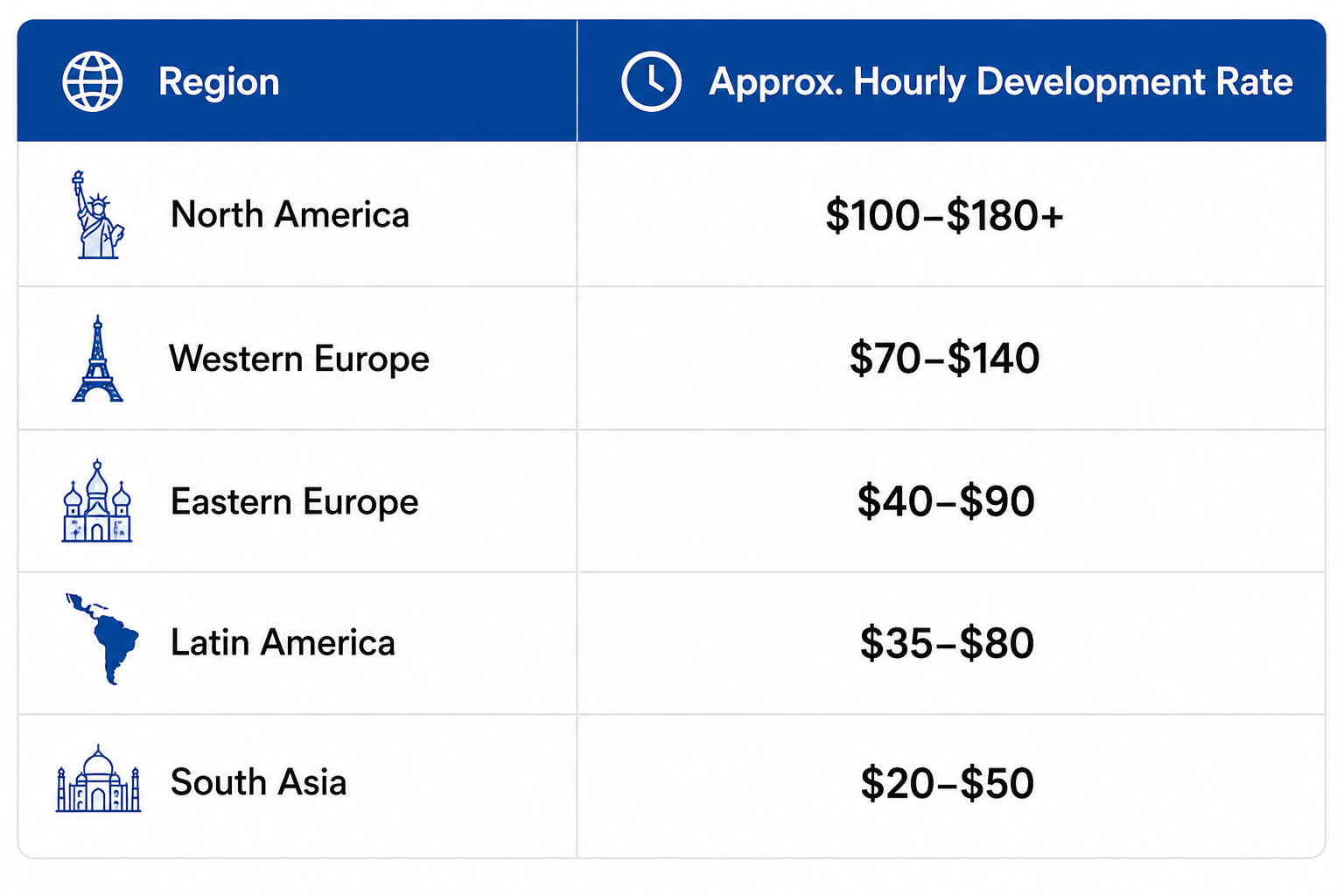
These are broad market ranges, and actual pricing varies based on expertise, project complexity, company size, and engagement model.
Choosing a lower hourly rate does not automatically mean a lower final cost. A more experienced team may complete complex work faster and reduce expensive rework later.
Cost by Retail Software Complexity
Basic Retail Application
A basic solution generally focuses on a limited set of business operations, such as product management, inventory tracking, sales records, employee access, and simple reports.
This type of project may cost approximately $20,000–$50,000 and can take around two to four months.
It is often suitable for small retailers or businesses that want to replace spreadsheets and disconnected tools with one centralized system.
Mid-Level Retail Platform
A mid-range product typically supports more users, business workflows, and integrations.
It might include customer accounts, promotions, loyalty programs, advanced reporting, payment integration, order management, and support for multiple locations.
Development can fall between $50,000 and $100,000, with a typical timeline of four to seven months.
Advanced Retail Platform
An advanced system is designed for businesses with more complex operations. It may connect physical stores, online channels, warehouses, suppliers, delivery services, and customer-facing applications.
Features such as real-time synchronization, sophisticated analytics, personalized experiences, extensive integrations, and automated workflows can push the budget to $100,000–$250,000 or more.
Enterprise projects can go considerably beyond this range when they involve large-scale infrastructure, custom hardware integration, extensive security controls, international operations, or highly specialized workflows.
Hidden Costs You Should Include in Your Budget
The development quote is only part of the financial picture.
Businesses should also account for expenses that appear before or after the core development phase.
These may include:
- Cloud infrastructure: Hosting, storage, databases, backups, and traffic costs can grow as usage increases.
- Third-party services: Payment processing, SMS, email, maps, analytics, authentication, and other external services may charge monthly or usage-based fees.
- Testing and quality assurance: Extensive testing becomes increasingly important as the number of devices, integrations, and workflows grows.
- Maintenance: Software needs updates, security patches, bug fixes, performance improvements, and compatibility changes.
- Support: Internal teams may need technical assistance after launch, particularly during the early stages.
- App store and infrastructure expenses: If the solution includes mobile applications, developer accounts, certificates, distribution, and related services should be considered.
Planning for these expenses from the beginning can prevent unpleasant budget surprises later.
How Much Does It Cost to Build a Retail App?
A retail mobile app can cost roughly $25,000–$150,000+, depending on what it needs to accomplish.
A simple shopping application with product browsing, accounts, cart functionality, checkout, and order tracking will generally cost less than an app that includes loyalty programs, personalized offers, barcode scanning, store pickup, location-based services, real-time inventory, and advanced customer engagement.
Building for both iOS and Android can also increase the budget, although cross-platform technologies may reduce duplicated development work in some cases.
Custom Retail Software vs. Off-the-Shelf Solutions
Buying an existing retail product can appear cheaper at first, especially for businesses with standard requirements.
However, off-the-shelf software often comes with limitations around customization, integrations, workflows, ownership, and long-term scalability.
Custom development tends to make more sense when a business has unique processes or needs software that can evolve alongside its operations.
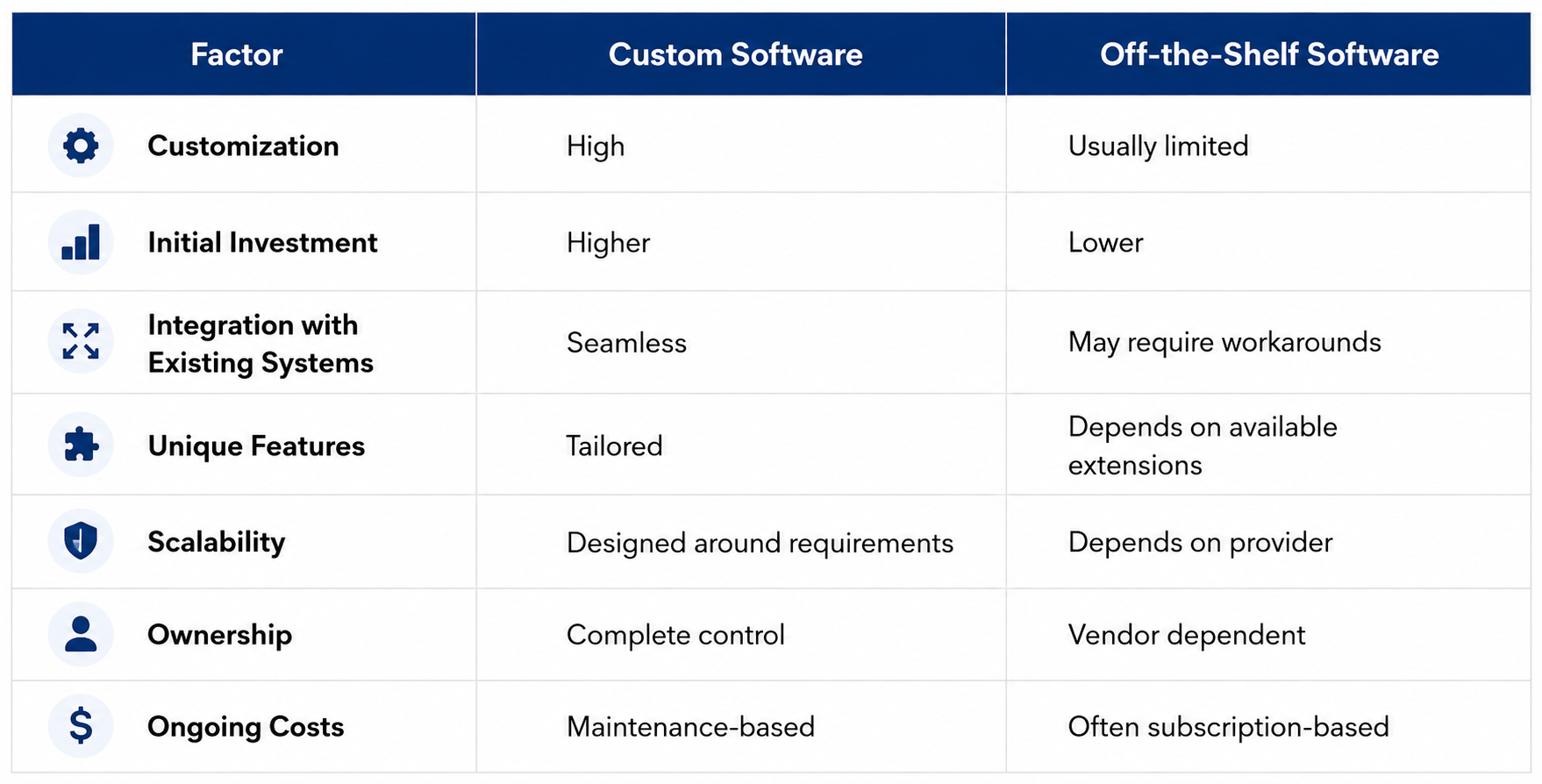
The right choice depends on the business rather than simply choosing the lowest initial price.
Learn More: Travel & Hospitality App Development: Build an AI Booking App
How to Reduce Retail Software Development Costs
Keeping the project affordable does not mean removing everything important. A better approach is to control scope and prioritize features according to business value.
Start with the workflows that have the greatest impact on revenue, efficiency, or customer experience. Build those first, measure how users respond, and then expand the platform based on real requirements.
A few practical ways to control spending include:
- Define the core requirements before development begins.
- Separate essential features from future enhancements.
- Use reusable components where appropriate.
- Select integrations carefully instead of connecting every available service.
- Choose the right technology for the project’s actual needs.
- Test important workflows early rather than waiting until the final stage.
- Keep the first release focused and expand it in planned phases.
A well-defined scope can save more money than simply negotiating a lower development rate.
Why Businesses Are Investing in E-Commerce & Retail Software Development in 2026
Retailers are under growing pressure to deliver faster service while managing increasingly complex operations. Customers now expect accurate product availability, convenient checkout, personalized offers, flexible delivery options, and a consistent shopping experience across online and offline channels.
At the same time, businesses need better visibility into inventory, sales, customer behavior, employee performance, and operating costs. This is where E-Commerce Software Development can help businesses bring essential processes together instead of relying on multiple disconnected systems.
A well-planned retail platform can reduce manual tasks, improve decision-making, streamline daily operations, and give businesses the flexibility to adapt as their needs change. More importantly, the right solution can create a stronger foundation for growth while helping retailers deliver a smoother experience to both customers and employees.
How to Estimate Your Retail Software Budget
Before contacting a development company, prepare a basic project brief.
Include the type of retailer, target users, platforms required, major workflows, expected integrations, number of locations, approximate user volume, security requirements, and desired launch date.
From there, divide the project into three levels:
Phase 1 — Core product: The features needed to launch and solve the primary business problem.
Phase 2 — Expansion: Additional functionality based on customer and employee feedback.
Phase 3 — Optimization: Performance improvements, automation, advanced reporting, deeper integrations, and new capabilities.
This approach makes the investment easier to manage and gives the business flexibility to adjust priorities as requirements become clearer.
Partner with Trisha Global Tech for Retail Software Development
Choosing the right technology partner can make a significant difference when you are planning a retail software project. At Trisha Global Tech, we focus on creating software solutions that align with the way your business actually operates. Instead of taking a one-size-fits-all approach, our team works around your goals, workflows, target users, and required features.
From inventory and order management to customer engagement, payment integration, analytics, and other retail functionalities, we help businesses plan and develop solutions that are practical, scalable, and easy to use. We also understand that every retail business has different priorities, which is why the development scope can be tailored according to your requirements and budget.
Whether you are starting a new retail platform or improving an existing system, Trisha Global Tech can help turn your ideas into a reliable digital solution. Our focus is on building software that supports smoother operations, better customer experiences, and long-term business growth.
Final Thoughts
The cost of custom retail software development in 2026 can range from $20,000 for a relatively simple application to $250,000+ for a complex enterprise platform. There is no universal price because every retail business has different processes, users, integrations, and growth plans.
Instead of focusing only on the initial development quote, evaluate the total investment, expected business value, scalability, security, maintenance requirements, and long-term flexibility.
A clear scope and phased development strategy can help you build the right solution without spending heavily on features that may not deliver meaningful value.
FAQs
Q 1: How much does custom retail software development cost in 2026?
Ans: Custom retail software can cost anywhere from around $20,000 to $250,000 or more. A simple application may fall toward the lower end, while feature-rich and enterprise platforms can require a significantly larger budget.
Q 2: How long does it take to develop retail software?
Ans: A basic retail application may take two to four months. More complex platforms commonly require four to twelve months or longer, depending on the number of features, integrations, platforms, and testing requirements.
Q 3: What is the biggest factor affecting retail software development cost?
Ans: Project scope is usually the biggest factor. The number and complexity of features, integrations, user roles, supported platforms, security requirements, and business workflows all influence the final budget.
Q 4: Is custom retail software more expensive than ready-made software?
Ans: The initial investment is usually higher, but custom software can provide greater control and flexibility. It can be worthwhile when standard products cannot support a retailer’s specific workflows or long-term requirements.
Q 5: How much does a retail mobile app cost?
Ans: A retail mobile application can cost approximately $25,000–$150,000 or more. The actual figure depends on features such as shopping, payments, loyalty programs, barcode scanning, order tracking, store pickup, and integrations.
Q 6: Can small retailers afford custom software?
Ans: Yes. Small retailers do not necessarily need to build a large platform from day one. Starting with essential functions and expanding gradually can make a tailored solution more financially practical.
Q 7: What ongoing expenses should retailers consider?
Ans: Common ongoing expenses include hosting, third-party services, technical support, maintenance, security updates, monitoring, backups, and future improvements.
Q 8: How can I reduce the cost of developing retail software?
Ans: Start with the most important business requirements, limit the first release to essential functionality, reuse proven components where suitable, avoid unnecessary integrations, and introduce additional features in later phases.
Q 9: Should retail software support both web and mobile platforms?
Ans: That depends on how customers and employees will use the system. If both channels are important to the business, supporting multiple platforms may provide broader reach, but it will also affect development and testing costs.
Q 10: Is investing in custom retail software worth it?
Ans: It can be worthwhile when the software solves meaningful operational problems, reduces manual work, improves customer experiences, or supports growth. The decision should be based on expected business value rather than development cost alone.