
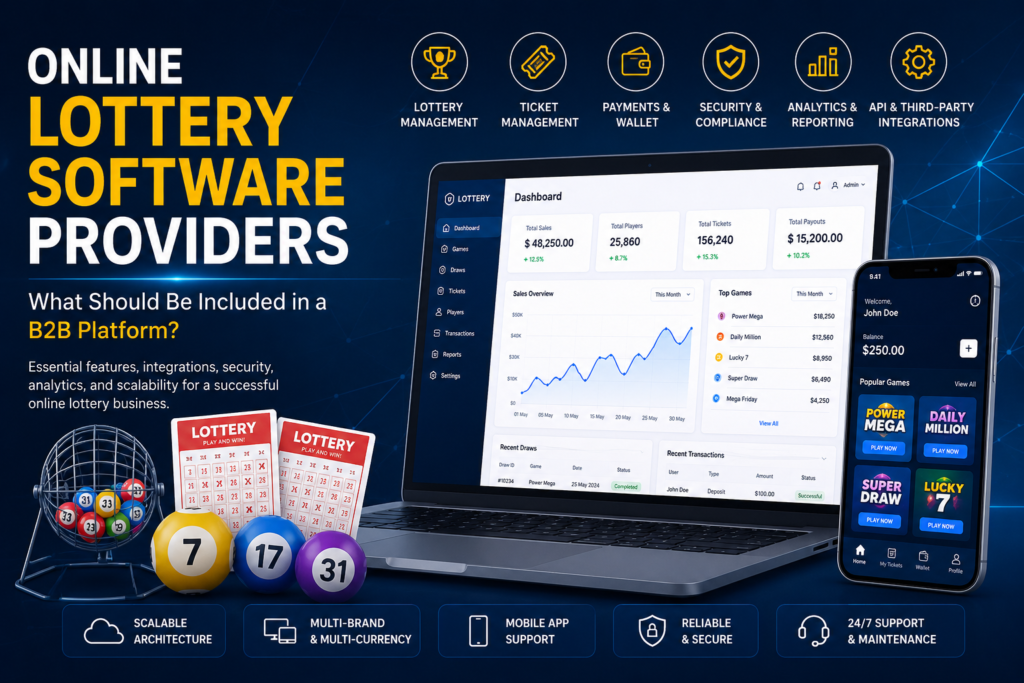
What Is B2B Online Lottery Software and How Does It Work?
B2B online lottery software is the technology that businesses use to launch, operate, and manage an online lottery platform. Instead of building every part of the system from scratch, an operator can work with a software provider that supplies the core technology needed to run lottery games, manage players, process transactions, handle tickets, publish results, and monitor day-to-day operations.
A B2B lottery platform typically works behind the scenes as the main operating system for an online lottery business. It connects different parts of the operation, including the player-facing website or app, lottery games, payment systems, user accounts, administration tools, reporting, and third-party services.
How Does B2B Lottery Software Work?
The process can be fairly straightforward from the player’s perspective. A player creates an account, selects a lottery game, purchases a ticket, and receives confirmation through the website or mobile application. Once the draw takes place, the platform processes the results and identifies winning tickets according to the configured game rules.
Behind that simple experience, the software handles a much wider range of tasks. It can manage player accounts, ticket records, wallets and transactions, draw schedules, game settings, reports, notifications, and administrative controls. It can also connect with external services such as payment gateways, identity verification providers, analytics tools, and other business systems.
For a B2B operator, this means the platform provides the infrastructure needed to manage the lottery business from a centralized environment rather than relying on multiple disconnected systems.
B2B Lottery Software vs. a Basic Online Lottery Website
A basic lottery website mainly focuses on what customers see. It may display available games, provide information about draws, and allow users to purchase tickets.
A B2B lottery platform goes much further. It is designed to support the business operations behind the website or app.
For example, a complete B2B platform may include:
- Lottery and game management
- Ticket creation and validation
- Draw and result management
- Player account management
- Wallet and payment processing
- KYC and age-verification integrations
- Reporting and analytics
- Administrative dashboards
- API and third-party integrations
- Security and access controls
- Mobile and web support
- Multi-brand or multi-market capabilities
This distinction is important when comparing online lottery software providers. A visually appealing website does not necessarily mean that the underlying technology is suitable for running a full-scale lottery operation.
What Does a Lottery Software Provider Do?
A lottery software provider supplies the technology and services required to operate the platform. Depending on the business model, the provider may offer a ready-made solution, a customizable platform, or fully tailored lottery software development.
The provider’s role can cover areas such as platform development, system integration, customization, hosting, maintenance, technical support, security updates, and ongoing improvements.
For businesses considering online lottery platform development, choosing the right provider is therefore about more than selecting software with a list of features. The provider should be able to understand the operator’s business requirements and provide technology that can support its expected users, payment methods, integrations, operational processes, and future growth.
In simple terms, B2B online lottery software provides the technology foundation, while the lottery operator uses that foundation to run and grow its lottery business.
Core Lottery Management Features Every B2B Platform Should Include
A reliable B2B lottery platform needs more than a system for selling tickets. Operators need tools that make it easier to create and manage lottery games, organize draws, track tickets, manage prizes, and keep everyday operations under control.
The exact features can vary depending on the operator’s business model, but a well-rounded lottery management software solution should cover the core areas below.
1. Game and Lottery Management
The platform should allow operators to create and manage different lottery games from a central dashboard. Administrators may need to configure game rules, ticket prices, draw schedules, prize structures, number combinations, and other game-specific settings.
Having these controls in one place makes it easier to launch new games, update existing ones, and manage multiple lottery products without making changes across several separate systems.
2. Draw Management
Draw management is another essential part of lottery software. The platform should provide tools for scheduling upcoming draws, managing draw information, recording results, and publishing winning numbers.
A well-organized draw management system can also maintain previous draw records, making it easier for operators and administrators to review results when needed.
3. Ticket Management and Validation
Every ticket needs to be recorded accurately from the moment it is purchased through the completion of the draw.
B2B lottery software should support ticket generation, ticket records, validation, status tracking, and winning-ticket identification. Players should also be able to view their ticket history and relevant draw information from their accounts.
For operators, centralized ticket management helps reduce manual work and provides a clear record of transactions and ticket activity.
4. Prize and Jackpot Management
Prize management allows operators to configure and monitor prize structures according to the rules of each game. Depending on the platform, this can include fixed prizes, variable prizes, jackpot amounts, winning categories, and payout information.
The software should also make it easy for administrators to review prize-related data and maintain accurate records of winning tickets and payouts.
5. Results Management
Once a draw is completed, results need to be recorded and made available to players and administrators.
A lottery management platform should provide a structured way to enter, verify, store, and publish results. Historical results can also be maintained so users can check previous draws while operators retain an accessible record for reporting and administration.
6. Centralized Administrative Controls
A B2B platform should bring these functions together through an easy-to-use administration panel. Authorized staff should be able to manage games, draws, tickets, prizes, users, and reports without needing to access multiple systems.
Role-based permissions can also help businesses control which members of their team can view or change specific areas of the platform.
What Should Businesses Look for in Lottery Management Software?
When comparing lottery management software providers, businesses should look beyond the number of features listed on a provider’s website. The more important question is whether those features work together as part of a reliable platform.
Look for software that offers:
- Centralized game and draw management
- Accurate ticket tracking and validation
- Flexible prize and jackpot configuration
- Clear results management
- Detailed administrative controls
- Reporting and audit capabilities
- Integration options for payments and other business systems
- Scalability for future growth
The goal is to choose lottery management software that can support daily operations efficiently while giving the business enough flexibility to expand its games, users, integrations, and markets over time.
Player, Wallet & Payment Management Capabilities
A smooth player experience depends heavily on how well the platform handles accounts, payments, and transactions. For a B2B lottery operator, these functions also need to be easy to manage from the administrative side.
A good lottery platform should give players a simple way to create and manage their accounts while providing operators with the tools to monitor transactions, manage balances, and connect with suitable payment services.
1. Player Account Management
The platform should provide a secure account area where players can register, log in, update their details, view purchased tickets, check transaction history, and manage their account preferences.
For operators, player management tools should make it possible to view account activity, manage user permissions, and access relevant account information when required.
2. Digital Wallet
A built-in wallet allows players to manage funds within their lottery account. Players can typically add funds, use their balance to purchase tickets, and request withdrawals where supported.
From the operator’s side, the wallet system should maintain accurate transaction records and provide visibility into deposits, withdrawals, balances, and related activity.
3. Payment Gateway Integration
Different markets and customer groups may prefer different payment methods. For this reason, online lottery software development should take payment integration into account from the beginning.
A B2B platform should be capable of connecting with suitable payment gateways and supporting the payment methods required by the operator’s target market.
Depending on the business requirements, integrations may include:
- Credit and debit cards
- Bank-based payment methods
- Digital payment services
- Local payment options
- Other approved payment providers
The available payment methods will depend on the operator’s location, target market, licensing requirements, and agreements with payment providers.
4. Deposits and Withdrawals
Players should be able to add funds and request withdrawals through a straightforward process. The platform should record each transaction and show its current status.
On the administrative side, authorized staff should be able to review transactions, identify pending requests, and access relevant payment information.
5. Transaction Tracking and Reconciliation
Accurate transaction records are important for both operators and customers. The software should maintain a clear history of deposits, withdrawals, ticket purchases, refunds where applicable, and other account activity.
Reporting and reconciliation tools can help operators compare platform transactions with payment provider records and identify discrepancies more quickly.
6. Payment Security
Payment handling should be supported by appropriate security measures and integrations with trusted payment providers. Sensitive payment information should be handled according to applicable security and regulatory requirements.
A good B2B lottery platform should also provide appropriate access controls, transaction monitoring, and activity records to help operators manage financial activity responsibly.
Why Player and Payment Management Matters
For players, the payment process should feel simple and predictable. For operators, it needs to be reliable, traceable, and manageable at scale.
When evaluating lottery software providers, businesses should therefore look at the complete payment journey—not just whether a provider supports a particular payment gateway. The platform should be flexible enough to accommodate the operator’s target markets, transaction requirements, future integrations, and growing customer base.
For the next section, I’d keep the focus on trust, platform protection, and operational safeguards, while avoiding claims that software alone guarantees legal compliance.
KYC, AML, Security & Responsible Gaming Features
Security and responsible account management are important parts of any B2B lottery platform. When a platform handles player accounts, payments, tickets, and personal information, operators need the right tools to help protect users and manage potential risks.
The exact requirements can vary by country and licensing authority, so the software should be flexible enough to work with the compliance processes that apply to the operator’s target market.
1. KYC and Age Verification
KYC (Know Your Customer) tools help operators verify player information before providing access to certain services. A lottery platform can integrate with external identity and age-verification providers to support this process.
Useful capabilities may include:
- Identity verification integrations
- Age verification
- Document verification
- Player information management
- Verification status tracking
- Account restrictions where verification is incomplete
This allows operators to manage verification processes from within their wider platform workflow.
2. AML and Transaction Monitoring
Anti-Money Laundering (AML) requirements can involve monitoring account and transaction activity for unusual patterns. A B2B lottery platform should be able to integrate with appropriate AML and risk-management services where required.
Depending on the market and operator’s requirements, this may include transaction monitoring, risk flags, account reviews, and relevant reporting tools.
The software should support these processes rather than treating compliance as a one-time check during registration.
3. Player and Transaction Security
Security should be considered throughout the platform, from account registration and login to ticket purchases and withdrawals.
Important areas to consider include:
- Secure authentication
- Role-based access controls
- Data encryption
- Secure API connections
- Transaction monitoring
- Activity logs
- Regular backups
- Controlled administrative access
A lottery software development company should also have a clear approach to maintaining and updating the platform as security requirements change.
4. Fraud Prevention
Lottery platforms can use different tools and controls to identify suspicious account or transaction activity.
Depending on the platform, these may include:
- Unusual transaction detection
- Account activity monitoring
- Duplicate or suspicious account checks
- Transaction limits
- Risk scoring integrations
- Manual review workflows
- Audit logs
These features can help operators identify activity that requires further investigation.
5. Responsible Gaming Controls
Responsible gaming tools can give players greater control over their activity while helping operators meet applicable requirements.
Depending on the jurisdiction and business model, features may include:
- Deposit limits
- Spending limits
- Session or activity limits
- Self-exclusion
- Cooling-off periods
- Account restrictions
- Responsible gaming notifications
These tools should be configurable according to the operator’s market and applicable rules.
6. Audit Trails and Access Management
A strong administrative system should keep records of important actions performed within the platform. Audit trails can help operators understand who made a particular change, when it happened, and what was changed.
Role-based permissions can further limit access to sensitive functions. For example, customer support staff may not need the same level of access as financial administrators or system managers.
Why These Features Matter When Choosing a Lottery Software Provider
When comparing online lottery software providers, security and compliance-related capabilities should be evaluated alongside features such as payments, ticket management, and reporting.
The right platform should provide the technical tools and integrations needed to support the operator’s compliance framework, protect sensitive information, manage account activity, and promote responsible use.
However, software features alone do not make an operation compliant. Operators are still responsible for obtaining the appropriate licenses, following local laws, and implementing the policies and procedures required in each jurisdiction.
Here’s the next section, keeping it practical and focused on the technology B2B buyers should expect from a modern platform.
API, Third-Party Integrations & Mobile Support
A B2B lottery platform rarely works as a standalone system. It usually needs to connect with payment services, identity verification tools, CRM platforms, analytics systems, and other business applications.
For this reason, strong API support and flexible integration options are important when comparing lottery software providers.
1. API Integration
APIs allow different systems to exchange information with the lottery platform. A well-designed API layer can make it easier to connect the platform with external services without rebuilding the core system each time.
Depending on the business requirements, a lottery platform may provide APIs for:
- Player account management
- Lottery games
- Ticket purchases
- Draw results
- Wallet transactions
- Deposits and withdrawals
- Notifications
- Reporting
- User authentication
Clear API documentation and proper access controls are also important, especially when external development teams need to work with the platform.
2. Payment and Financial Integrations
Payment integration is one of the most common requirements for online lottery software development. Operators may need to connect with different payment providers based on their target market.
A flexible platform should make it possible to add or change payment integrations without disrupting other parts of the system.
3. KYC, AML and Identity Verification Integrations
Rather than building every verification service internally, a lottery platform can connect with specialized third-party providers.
This can help operators integrate services for:
- Identity verification
- Age verification
- Document checks
- Risk screening
- Transaction monitoring
The platform should be able to receive and manage verification results while keeping the appropriate account records.
4. CRM, Analytics and Marketing Integrations
B2B operators often use separate tools for customer relationship management, marketing, analytics, and communication.
API connectivity can allow the lottery platform to exchange relevant data with these systems, helping businesses understand player activity and manage customer engagement more efficiently.
5. Mobile Web and Lottery App Support
Players increasingly expect to access lottery services through their smartphones. A B2B platform should therefore provide a mobile-friendly experience rather than treating mobile as an afterthought.
Depending on the business model, mobile support can include:
- Responsive web design
- Mobile ticket purchasing
- Player account access
- Wallet management
- Draw results
- Notifications
- Android applications
- iOS applications
For businesses planning lottery app development, the mobile application should work consistently with the main lottery platform so that player accounts, tickets, balances, and relevant activity remain synchronized.
6. Affiliate and Partner Integrations
If an operator works with affiliates or business partners, the platform may also need to connect with affiliate tracking and commission systems.
Integration capabilities can support functions such as referral tracking, campaign attribution, player registration data, and commission reporting.
What Should Businesses Check Before Choosing a Provider?
When evaluating Lottery Platform Developers or a Lottery Software Development Company, don’t simply ask whether APIs are available. Ask how flexible and practical those APIs are.
Consider questions such as:
- Is API documentation available?
- Can third-party systems be integrated easily?
- Are APIs secure and properly authenticated?
- Can new integrations be added later?
- Can the platform support mobile applications?
- Can different payment and verification providers be connected?
- Is technical integration support available?
A platform with a well-planned integration layer can give an operator more flexibility as the business expands, adds new services, or enters additional markets.
Here’s the next section, with the emphasis on scalability and the B2B capabilities that become important when an operator manages multiple brands or markets.
Multi-Brand, Multi-Currency & Scalable Platform Architecture
As a lottery business grows, its technology needs can change quickly. An operator may want to launch additional brands, support more players, introduce new lottery games, or expand into markets with different currencies and languages.
For this reason, lottery platform development should be planned with future growth in mind rather than focusing only on the initial launch.
1. Multi-Brand Support
A B2B lottery platform should be able to support multiple brands from a centralized system where the business model requires it.
Each brand may need its own:
- Website or mobile experience
- Branding and design
- Lottery games
- Promotions
- Player accounts
- Payment options
- Content
- Reporting
At the same time, the operator can benefit from shared underlying technology and centralized administration.
This can make managing several lottery brands more efficient than maintaining completely separate platforms for each business.
2. Multi-Tenant Architecture
Multi-tenant architecture allows a single platform to serve different operators or business units while keeping their data and configurations appropriately separated.
This can be particularly useful for lottery management software providers serving multiple B2B clients.
A well-designed setup can allow each tenant to have its own:
- Users and player data
- Games and configurations
- Brand settings
- Payment integrations
- Reports
- Administrative permissions
The exact architecture should depend on the provider’s technology and the operator’s security, performance, and business requirements.
3. Multi-Currency and Multi-Language Capabilities
Businesses operating across different markets may need to support more than one currency and language.
A flexible platform can help manage:
- Multiple currencies
- Currency conversion rules
- Localized content
- Multiple languages
- Market-specific configurations
- Local payment options
These capabilities can make it easier to adapt the same technology to different customer groups without rebuilding the entire platform.
4. Scalable Infrastructure
A growing player base means more account activity, ticket purchases, transactions, and data. The platform should be capable of handling increased demand without requiring a complete technical rebuild.
Depending on the architecture, scalability may involve:
- Cloud infrastructure
- Load balancing
- Database optimization
- Caching
- Horizontal scaling
- Performance monitoring
- Automated backups
- Disaster recovery planning
The goal is to create an environment that can grow alongside the business.
5. Handling Traffic During High-Demand Periods
Lottery platforms can experience significant increases in activity around popular draws, major jackpots, promotions, or other campaigns.
A scalable platform should be designed to handle these periods while maintaining a consistent experience for users.
This is why businesses evaluating online lottery platform development should ask providers how their systems handle traffic increases, transaction volumes, and unexpected demand.
6. Flexible Architecture for Future Growth
Scalability isn’t only about handling more users. The platform should also make it possible to add new capabilities over time.
For example, an operator may later want to introduce:
- New lottery games
- Additional payment methods
- Mobile applications
- New third-party integrations
- Additional brands
- New reporting requirements
- Additional markets
A flexible architecture can reduce the need for major redevelopment whenever the business introduces something new.
Why Scalability Matters When Choosing a Lottery Software Provider
A platform that works well for a small operation may not necessarily be suitable for a growing B2B business.
When comparing lottery software providers, look at the platform’s current capabilities as well as its ability to support future expansion. A scalable solution can give operators more room to grow while reducing the risk of outgrowing their technology too quickly.
For businesses planning long-term lottery platform development, scalability, multi-brand support, integration flexibility, and reliable infrastructure should therefore be considered from the beginning.
Admin Dashboard, Analytics & Business Reporting
A B2B lottery platform should give operators a clear view of what is happening across the business. An admin dashboard brings important information and controls into one place, while analytics and reporting help teams understand sales, player activity, transactions, and game performance.
These tools are especially useful as the number of players, games, transactions, and brands increases.
1. Centralized Admin Dashboard
The admin dashboard acts as the main control area for the lottery platform. Authorized staff should be able to manage important functions without switching between several systems.
Depending on the platform, administrators may be able to manage:
- Players and user accounts
- Lottery games
- Draws and results
- Tickets
- Payments and transactions
- Promotions
- Content
- Affiliates
- Reports
- Platform settings
A well-organized dashboard can also provide different levels of access, allowing each team member to see only the functions relevant to their role.
2. Player Activity Reports
Understanding player activity can help operators identify trends and monitor how customers interact with the platform.
Useful reports may include:
- New registrations
- Active players
- Ticket purchases
- Deposit activity
- Withdrawal activity
- Player retention
- Account activity
- Game participation
These insights can help businesses evaluate which parts of the platform are performing well and where improvements may be needed.
3. Lottery and Game Performance Analytics
Operators need to know how individual lottery games are performing. The platform should make it possible to review information such as ticket sales, participation, prize distribution, and draw activity.
Comparing different games can help businesses understand customer preferences and make better decisions about their lottery portfolio.
4. Financial and Transaction Reporting
Financial reporting is another important part of lottery management software.
A platform may provide reports covering:
- Deposits
- Withdrawals
- Ticket sales
- Payouts
- Revenue
- Transaction volumes
- Refunds where applicable
- Payment status
- Reconciliation data
Reports should ideally be easy to filter, review, and export for use by finance and management teams.
5. Real-Time Business Insights
Where supported by the platform, real-time or near-real-time dashboards can give operators a current view of important activity.
For example, teams may be able to monitor ticket sales, active users, transactions, and game performance while campaigns or major draws are running.
This can be particularly useful when a business needs to respond quickly to changes in activity.
6. Role-Based Access and Administrative Controls
Not every employee needs access to every part of the system. Role-based access can help businesses control administrative permissions.
For example:
- Customer support teams can manage player-related requests.
- Finance teams can access relevant transaction information.
- Marketing teams can manage campaigns.
- Platform administrators can manage technical settings.
This approach helps limit unnecessary access to sensitive information and platform functions.
7. Customizable Reports
Different businesses have different reporting needs. A useful B2B platform should provide enough flexibility to create or configure reports around the operator’s requirements.
The ability to filter information by date, game, brand, player segment, transaction type, or other relevant criteria can make reporting much more useful than relying on fixed reports alone.
Why Admin and Reporting Tools Matter
When comparing Lottery Management Software providers, businesses should evaluate the administration and reporting experience just as carefully as the player-facing features.
A strong dashboard should make everyday management easier, while accurate reporting should give decision-makers a clear understanding of the business.
Ultimately, the value of these tools comes from turning platform activity into information that operators can actually use to manage operations, identify trends, and plan future growth.
For the next section, I’d move from platform features to what the provider itself should deliver, which keeps the article commercially focused and helps support lead generation.
Learn More: Online Lottery Software Development Guide 2026: Cost & Features
What Should You Expect From a Lottery Software Provider?
Choosing a lottery software provider is not simply about finding a platform with the longest feature list. For a B2B business, the provider’s technical capabilities, customization options, support, and ability to understand the operator’s requirements can be just as important as the software itself.
A suitable provider should be able to support the business before launch and continue providing technical assistance as the platform develops.
1. A Platform That Fits Your Business Requirements
Every lottery business has different requirements. Some operators may need a ready-to-launch solution, while others may require extensive customization or a completely tailored platform.
Before choosing a provider, consider whether its solution can support your:
- Lottery products and game formats
- Target markets
- Business model
- Player volumes
- Payment requirements
- Mobile strategy
- Integration needs
- Multi-brand plans
The platform should fit the business rather than forcing the business to work around unnecessary limitations.
2. Customization and Development Support
A B2B platform may need changes to match an operator’s branding, workflows, integrations, or specific business requirements.
A capable lottery software development company should be able to explain which parts of the platform can be customized and which are fixed.
Customization may include:
- User interface and branding
- Game configurations
- Admin workflows
- Payment integrations
- APIs
- Reports
- Mobile applications
- Player features
Clear communication about customization from the beginning can help prevent unexpected development work later.
3. Integration Expertise
Most lottery platforms need to work with other systems. The provider should therefore have experience integrating external services such as payment gateways, KYC providers, CRM platforms, analytics tools, and other business applications.
Ask the provider how new integrations are handled and whether the platform has documented APIs for future development.
4. Security and Platform Maintenance
A lottery platform needs ongoing attention after launch. Security updates, bug fixes, performance improvements, infrastructure monitoring, and technical maintenance can all become part of the platform’s lifecycle.
When evaluating lottery software providers, ask what ongoing maintenance is included and how security issues or technical problems are handled.
5. Scalability and Future Development
Your initial requirements may change as the business grows. A provider should be able to explain how the platform can accommodate more players, transactions, games, brands, or integrations over time.
It is also worth asking whether the provider has a development roadmap and how new functionality can be added when business requirements change.
6. Technical and Post-Launch Support
Launching the platform is only one stage of the project. After launch, the operator may need help with technical issues, integrations, configuration changes, updates, and performance-related concerns.
Before signing an agreement, clarify:
- Support availability
- Response times
- Maintenance responsibilities
- Upgrade process
- Technical escalation procedures
- Additional development costs
- Post-launch support terms
Having these details clearly defined can make the relationship between the operator and provider much easier to manage.
7. Clear Communication and Project Transparency
Good technology is important, but communication also plays a major role in a successful B2B project.
The provider should be able to explain the development process, project scope, timelines, integrations, costs, and responsibilities in language that business teams can understand.
A provider that communicates clearly from the planning stage can make it easier for the operator to make informed decisions throughout the project.
What Makes a Good B2B Lottery Software Provider?
The right provider should offer more than software. It should provide a combination of technology, customization, integration expertise, security, scalability, and ongoing support that matches the operator’s business goals.
When comparing Lottery Platform Developers or a Lottery Software Development Company, look beyond the product demonstration. Evaluate how well the provider understands your requirements and whether it can continue supporting the platform as your business evolves.
How to Choose the Right Online Lottery Software Provider
Choosing the right online lottery software provider like Trisha Global Tech is an important decision, as the platform can become a central part of the business’s daily operations. While features and pricing are important, businesses should also consider how well the provider can support their specific requirements today and in the future.
The best choice will depend on factors such as the business model, target market, required integrations, expected player volume, and level of customization.
1. Start With Your Business Requirements
Before comparing providers, it helps to clearly define what the platform needs to support.
Consider questions such as:
- What types of lottery games will you offer?
- Which markets do you plan to target?
- Do you need a web platform, mobile app, or both?
- Which payment methods are required?
- Do you need third-party integrations?
- Will you operate multiple brands?
- How much customization do you need?
Having clear requirements makes it easier to identify whether a provider’s platform is actually suitable for your business.
2. Evaluate the Platform’s Core Features
A provider may offer many features, but not every feature will be relevant to your operation. Focus on the capabilities that directly support your business model.
Important areas may include:
- Lottery and game management
- Ticket management
- Draw and results management
- Player account management
- Wallet and payment functionality
- Reporting and analytics
- Administrative controls
- Mobile support
Rather than simply comparing feature lists, ask the provider to explain how these functions work in practice.
3. Check Customization and Flexibility
Some businesses need a ready-made solution, while others require a platform that can be adapted to their brand, workflows, games, or integrations.
When speaking with a lottery software development company, ask which parts of the platform can be customized and how additional development requests are handled.
It is also useful to understand whether customization will affect future updates, maintenance, or platform upgrades.
4. Review Integration Capabilities
A modern lottery platform may need to connect with payment providers, KYC services, CRM systems, analytics tools, and other third-party applications.
Ask whether the provider offers:
- Documented APIs
- Existing third-party integrations
- Custom integration support
- Technical documentation
- Ongoing integration assistance
A flexible integration structure can make it easier to add new services as the business grows.
5. Consider Security and Operational Controls
Businesses should understand how the provider approaches platform security, access management, data protection, backups, and technical maintenance.
It is also important to review the platform’s available tools for account verification, transaction monitoring, audit records, and responsible gaming controls where relevant to the operator’s requirements.
Software capabilities should always be assessed alongside the legal and regulatory obligations that apply to the markets in which the operator intends to work.
6. Assess Scalability
A platform should not only meet current requirements but also provide room for future growth.
Ask the provider how the system can support:
- Increased player numbers
- Higher transaction volumes
- Additional lottery games
- New payment methods
- Multiple brands
- New markets
- Additional integrations
This is particularly important for businesses planning long-term online lottery platform development.
7. Understand the Complete Cost
The initial price of a platform does not always represent the total cost of operating it.
Ask for clarity around:
- Platform licensing or development costs
- Customization charges
- Integration costs
- Hosting and infrastructure
- Maintenance
- Technical support
- Future upgrades
- Additional development work
Understanding the full cost structure can make it easier to compare different lottery software providers on a like-for-like basis.
8. Evaluate Post-Launch Support
Technical support can become particularly important after the platform goes live.
Before selecting a provider, understand what happens when the business needs assistance with updates, integrations, technical issues, or future development.
A clear support structure should define responsibilities, communication channels, maintenance arrangements, and the process for handling technical problems.
Questions to Ask Before Choosing a Provider
Before making a final decision, businesses should ask:
- Can the platform support our current and future business model?
- Which features are included as standard?
- What can be customized?
- Which APIs and integrations are available?
- How does the platform handle growth and increased demand?
- What security and access controls are available?
- What ongoing maintenance is included?
- How is post-launch technical support handled?
- What additional costs should we expect?
- How can the platform be expanded in the future?
Choosing the right provider is not only about finding a platform that works today. The goal is to find a technology partner that can provide the flexibility, technical capabilities, and ongoing support needed as the business develops.
For the next section, I’d make it a practical comparison/checklist section that reinforces the commercial intent and naturally leads into the final CTA.
B2B Lottery Software Provider Evaluation Checklist
Before selecting a lottery software provider, businesses should evaluate the platform from both a technical and operational perspective. A provider may have an impressive product demo, but the real question is whether its software can support your business requirements reliably as the operation grows.
Use the following checklist to compare potential providers more effectively.
Platform & Lottery Management
Look for a platform that provides the essential tools needed to manage lottery operations from one place, including:
- Game and lottery management
- Draw scheduling and results management
- Ticket creation and validation
- Prize and jackpot management
- Player account management
- Centralized administration
Payments & Transactions
Check whether the platform can support the payment requirements of your target market.
Consider:
- Digital wallet functionality
- Deposit and withdrawal management
- Payment gateway integrations
- Transaction tracking
- Financial reporting
- Reconciliation tools
Security & Account Protection
Security should be considered throughout the platform rather than as a separate feature.
Ask providers about:
- User authentication
- Role-based access
- Data protection
- Secure API connections
- Transaction monitoring
- Fraud prevention tools
- Audit logs
- Backup and recovery procedures
APIs & Integrations
A flexible platform should be able to connect with the external services your business needs.
Check for:
- Documented APIs
- Payment integrations
- KYC and identity verification integrations
- CRM connectivity
- Analytics integrations
- Affiliate systems
- Mobile application support
- Custom integration capabilities
Scalability & Multi-Brand Support
If you plan to expand, make sure the technology can grow with your business.
Consider whether the platform supports:
- Multiple brands
- Multiple languages
- Multiple currencies
- Additional lottery games
- Increasing player volumes
- Higher transaction volumes
- New integrations
- Expansion into additional markets
Customization & Development
Not every business needs the same lottery platform. Ask whether the provider can customize the solution according to your requirements.
Find out:
- Which features can be customized?
- Can the user interface be branded?
- Can new integrations be developed?
- Can custom reports be created?
- Can the platform support future functionality?
- Is dedicated development support available?
This is particularly important when working with Lottery Platform Developers or a lottery management software development company for a tailored solution.
Analytics & Reporting
The platform should provide enough data for your teams to monitor operations and make informed business decisions.
Check whether reporting covers:
- Ticket sales
- Player activity
- Game performance
- Deposits and withdrawals
- Revenue
- Payouts
- Transactions
- Affiliate activity
- Financial reconciliation
Provider Support & Maintenance
Finally, evaluate the provider itself—not just its software.
Ask about:
- Implementation support
- Technical support
- Platform maintenance
- Security updates
- Bug fixes
- System monitoring
- Future upgrades
- Additional development
- Support response times
A strong technology partner should be able to support the platform beyond the initial launch.
Quick Checklist for Comparing Lottery Software Providers
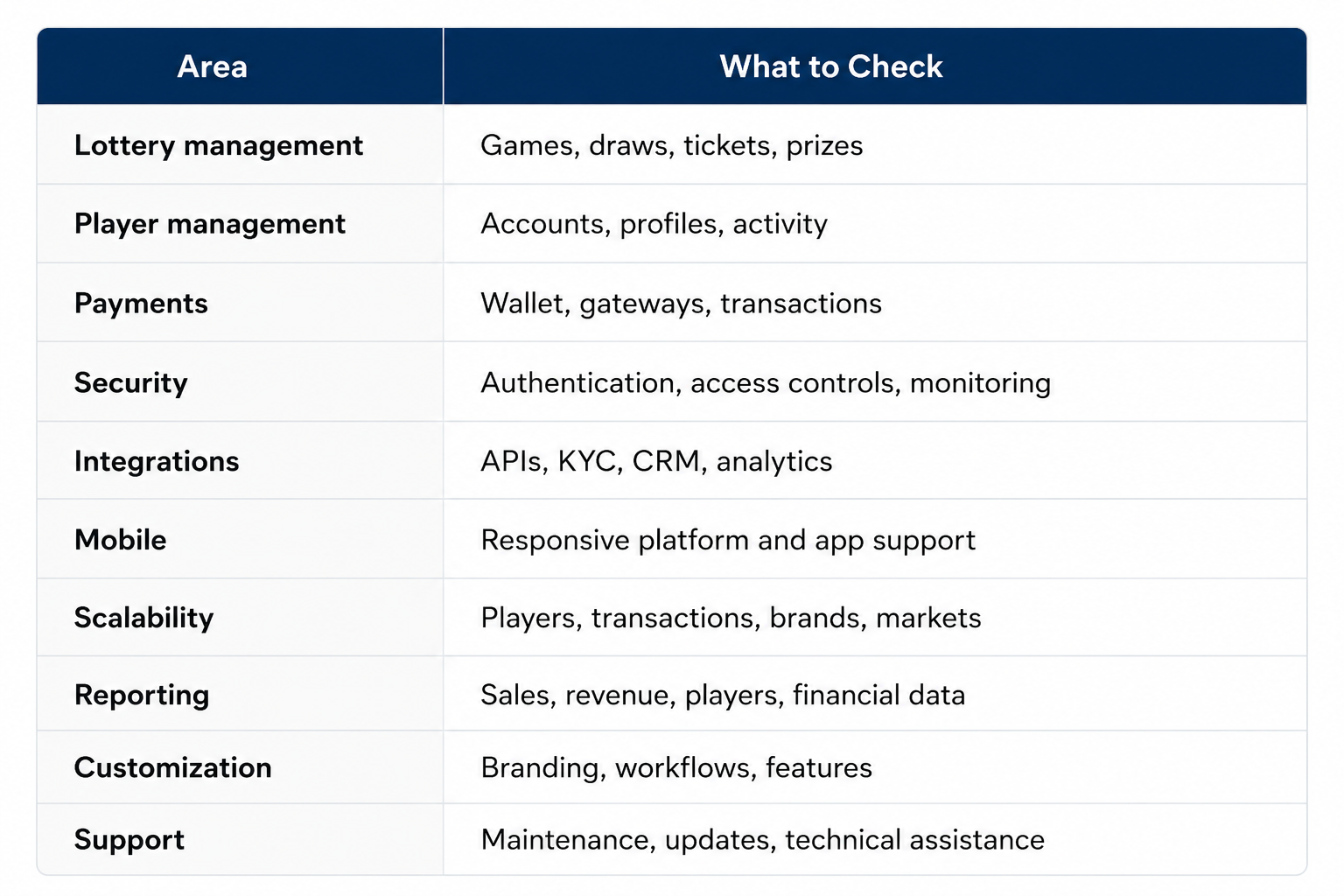
A provider that meets these requirements can offer a stronger foundation for long-term online lottery platform development. However, businesses should always evaluate the technology against their own operational, commercial, security, and jurisdiction-specific requirements before making a final decision.
Conclusion
Choosing the right online lottery software provider is about more than selecting a platform with a long list of features. A dependable B2B solution should bring together lottery management, ticketing, player accounts, payments, security, APIs, reporting, mobile support, and scalable architecture. Businesses should also consider customization, integration capabilities, ongoing maintenance, and technical support before making a decision. The right lottery software development company can provide the technology foundation needed to launch efficiently while supporting future business growth. By evaluating these areas carefully, operators can avoid costly limitations and choose a platform that fits their business model, operational needs, and long-term plans. Ultimately, the right technology partner can make online lottery platform development more manageable, flexible, and ready for growth.
FAQs
Q 1: What is B2B online lottery software?
Ans: B2B online lottery software is a technology platform that helps businesses manage lottery games, tickets, players, payments, draws, reporting, and other lottery operations from one system.
Q 2: What should an online lottery software platform include?
Ans: A B2B lottery platform should include game and draw management, ticketing, player accounts, payments, wallets, security, APIs, reporting, mobile support, and scalable infrastructure.
Q 3: How does B2B lottery software differ from a basic lottery website?
Ans: A basic lottery website focuses mainly on the player interface, while B2B lottery software also provides back-office tools for games, tickets, payments, users, reporting, integrations, and operations.
Q 4: What does a lottery software provider do?
Ans: A lottery software provider supplies the technology needed to operate a lottery platform and may also provide customization, integrations, deployment, maintenance, security updates, and technical support.
Q 5: What is lottery management software?
Ans: Lottery management software is a system used to manage lottery games, draws, tickets, players, prizes, transactions, reports, and administrative operations through a centralized platform.
Q 6: Can lottery software support multiple brands and currencies?
Ans: Yes, depending on the platform architecture, B2B lottery software can support multiple brands, currencies, languages, games, and markets from a shared technology infrastructure.
Q 7: What integrations are needed for an online lottery platform?
Ans: Common integrations include payment gateways, KYC and identity verification services, CRM systems, analytics tools, fraud monitoring solutions, affiliate platforms, and mobile applications.
Q 8: How much does online lottery software development cost?
Ans: The cost depends on platform complexity, customization, integrations, mobile requirements, security, scalability, infrastructure, and ongoing maintenance. There is no single fixed development cost.
Q 9: How do I choose the right lottery software provider?
Ans: Compare providers based on platform features, customization, APIs, security, scalability, integrations, total cost, technical expertise, maintenance, and post-launch support.
Q 10: Why choose [Brand Name] for lottery software development?
Ans: [Brand Name] provides lottery software development solutions tailored to business requirements, with capabilities for platform development, integrations, customization, mobile support, and ongoing technical needs.