
What Is Online Lottery Software Development?
Online lottery software development is the process of creating a digital system that allows lottery businesses to manage games, sell tickets, process transactions, publish draw results, and handle day-to-day operations through a single platform. Instead of relying on separate tools for players, payments, draws, and administration, everything can be connected within one secure online environment.
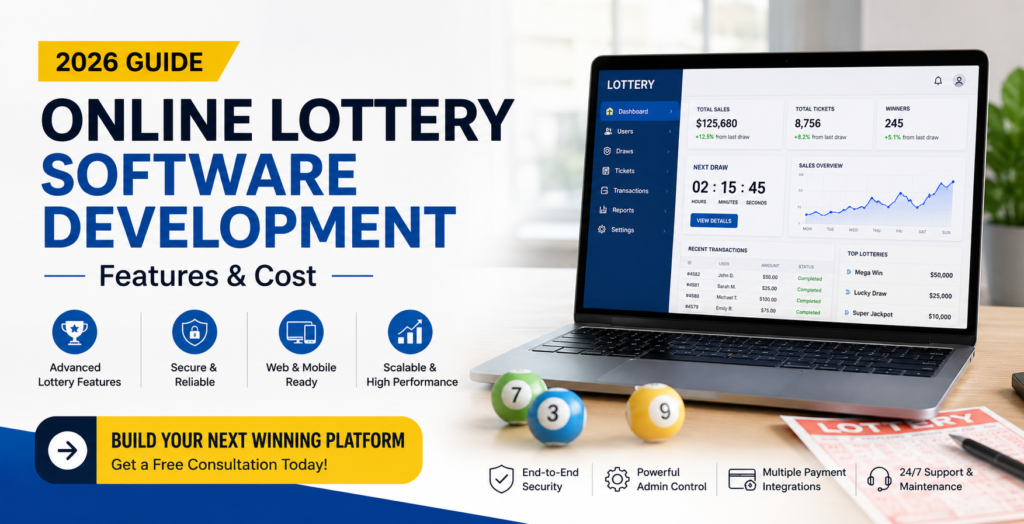
A typical Online Lottery Software Development solution has two main sides: the player interface and the administration panel. Players can create accounts, browse available lotteries, select or purchase tickets, make payments, check draw results, and view their transaction history. On the other side, operators can manage users, configure lottery games, monitor tickets and payments, publish results, and generate business reports.
How Does an Online Lottery Platform Work?
The process is relatively straightforward from a user’s perspective. A player first registers and completes any required verification. They can then choose a lottery, select their numbers or ticket, and complete the payment. Once the draw takes place, the winning numbers or results are published through the platform. If the player wins, the system can notify them and process the applicable prize or withdrawal request.
Behind the scenes, the platform handles tasks such as ticket records, payment tracking, draw management, user verification, notifications, and reporting. This helps operators manage a large number of users and transactions without depending on manual processes.
Lottery Software vs. Lottery Management Software
Although these terms are often used interchangeably, they can refer to different parts of a lottery business.
Lottery software generally focuses on the player-facing experience and the core functions needed to run online lottery games, such as ticket sales, payments, results, and user accounts.
Lottery Management Software is more focused on the operational side. It gives administrators tools to manage users, games, draws, payments, tickets, reports, promotions, and other business activities from one dashboard.
For larger operations, both can work together as part of a complete lottery ecosystem.
Who Uses These Platforms?
These solutions can be useful for different types of businesses, including lottery operators, gaming businesses, licensed lottery organizations, entrepreneurs launching a new lottery venture, and companies looking to move an existing lottery operation online.
The right setup depends on the business model, target market, required features, expected user volume, and applicable local regulations. A well-planned platform can give operators better control over daily operations while providing players with a simple and convenient way to participate.
Here’s a concise, natural section designed to flow smoothly after the first heading without repeating the same phrases too often:
How Does an Online Lottery Platform Work?
An online lottery platform connects the entire lottery process in one place, from player registration to ticket purchase and prize handling. While the experience is simple for users, the backend manages multiple activities in real time to keep transactions, tickets, draws, and results organized.
1. Registration and KYC
Players start by creating an account using their basic details. Depending on the market and applicable requirements, identity or age verification may also be completed before certain features become available. KYC checks help operators confirm user information and meet relevant regulatory requirements.
2. Wallet and Payment
After verification, players can add funds using the available payment methods. The wallet keeps track of deposits, ticket purchases, winnings, and eligible withdrawals. Payment integrations also allow transactions to be processed and recorded securely.
3. Ticket Purchase
Players can browse available lottery games, select their preferred numbers or ticket options, and complete the purchase. Once the payment is confirmed, the system records the ticket and provides the user with the relevant ticket details.
4. Draw and Result
When the scheduled draw takes place, the winning numbers or results are generated and published according to the operator’s approved process. Players can check the outcome through their accounts, while automated notifications can alert them when results are available.
5. Prize and Withdrawal
If a ticket matches the applicable winning criteria, the platform records the prize and updates the player’s account based on the configured rules. Eligible winnings can then be requested for withdrawal through the supported payment methods.
Role of the Admin Panel and Backend
The admin panel gives operators control over the platform’s daily activities. They can manage users, lottery games, tickets, payments, draws, results, KYC records, promotions, and reports from a centralized dashboard.
The backend works behind the scenes to connect these functions. It processes transactions, stores records, communicates with APIs, manages user activity, and keeps information synchronized across the platform. A well-planned Online Lottery Platform Development approach ensures that these components work together reliably as the number of users and transactions grows.
For this section, I’d keep the feature descriptions practical and concise so the article stays within the 1,500–2,000-word limit and doesn’t feel keyword-stuffed.
Essential Features of Online Lottery Software
A good lottery platform should make participation simple for players while giving operators enough control to manage games, users, payments, and daily activities. The exact feature set can vary depending on the business model and target market, but the following functions are generally important.
Player Features
- Easy Registration & Login: Users should be able to create an account and sign in through a simple, secure process. Verification options can also be added where required.
- Lottery Browsing: Players should be able to view available lotteries, ticket prices, draw schedules, rules, and other relevant information without navigating through complicated menus.
- Ticket Purchase: The platform should allow users to select numbers or ticket options, confirm their choices, and complete purchases with minimal steps.
- Wallet & Payments: A built-in wallet can help users manage deposits, ticket purchases, winnings, and eligible withdrawals. Multiple payment options can be integrated based on the target market.
- Results & Winning Information: Players should be able to quickly check previous and latest draw results, winning numbers, and applicable prize details.
- Notifications: Email, SMS, push, or in-app alerts can keep users informed about upcoming draws, results, transactions, and account-related updates.
- Transaction History: A clear record of deposits, purchases, winnings, and withdrawals helps users track their account activity.
Admin Features
- User Management: Administrators can manage player accounts, verification status, account activity, and access permissions from one dashboard.
- Lottery & Draw Management: Operators can create and configure lottery games, schedules, ticket rules, draw details, and result publishing.
- Ticket Management: The system can maintain ticket records, purchase details, statuses, and winning information for easier monitoring.
- Payment Management: Administrators can track deposits, withdrawals, payment status, refunds, and related transactions.
- Reports & Analytics: Business reports can provide insights into ticket sales, revenue, player activity, transactions, and lottery performance.
- KYC Management: The administration panel can help review and manage identity verification information according to the requirements of the applicable market.
Together, these capabilities allow Lottery Management Software to handle both player activity and operational tasks from a centralized system. Experienced Lottery Software Developers can also customize the feature set according to the platform’s business model, user volume, integrations, and regulatory requirements.
For this section, I’d keep the focus on practical 2026-ready capabilities, not buzzwords. Here’s a natural version that fits the flow of your article:
Advanced Features to Include in a Lottery Platform in 2026
As online lottery platforms become more competitive, basic ticketing and payment features are no longer enough. Modern platforms need better visibility, stronger controls, and the flexibility to serve users across different markets. The following features can add real value to a lottery business.
- Real-Time Analytics: Operators can monitor ticket sales, user activity, revenue, popular games, and transaction patterns through live dashboards. This makes it easier to identify changes in performance and make informed business decisions.
- Fraud Detection: Automated checks can help identify unusual transactions, suspicious account activity, duplicate accounts, or other risk signals. Combining transaction monitoring with proper verification processes can strengthen platform security.
- Automated Notifications: Players can receive timely alerts for upcoming draws, results, ticket purchases, payment updates, and important account activities through push notifications, email, SMS, or in-app messages.
- Multi-Language & Multi-Currency Support: Platforms targeting multiple regions can offer localized languages and currencies, making the user experience more convenient while simplifying operations across different markets.
- API Integrations: APIs allow the platform to connect with payment gateways, identity verification services, notification tools, analytics systems, and other third-party services without building every function from scratch.
- Cloud Scalability: Cloud-based infrastructure makes it easier to handle changes in traffic and transaction volume. Resources can be adjusted as the platform grows, helping maintain performance during busy periods such as major draws.
- Responsible Gaming Controls: Features such as spending limits, activity monitoring, self-exclusion options, age verification, and account controls can support safer participation and help operators meet applicable requirements.
- AI-Powered Insights: AI can help analyze large volumes of platform data to identify trends, understand player behavior, detect unusual patterns, and support better operational decisions. Its use should complement human oversight rather than replace important controls.
Together, these capabilities can make a lottery platform more flexible, secure, and easier to manage while preparing it for changing user expectations and business requirements in 2026.
Here’s a practical, concise section that fits the 1,500–2,000-word target and naturally includes the keywords without repetition:
How to Develop an Online Lottery Platform?
Building a lottery platform involves more than developing a website or mobile app. The business model, target market, user experience, security, integrations, and regulatory requirements all need to be considered before development begins. A typical Lottery Platform Development process can be broken down into the following steps.
1. Define the Business Model and Target Market
Start by deciding what type of lottery platform you want to operate, who it will serve, and which markets you plan to target. This helps determine the required features, payment options, languages, currencies, and technical requirements.
2. Identify Regulatory Requirements
Lottery businesses are subject to rules that can vary significantly by jurisdiction. Before development starts, identify applicable licensing, age verification, KYC, responsible gaming, data protection, and other regulatory requirements with appropriate legal guidance.
3. Finalize the Features
Create a clear feature list for both players and administrators. This may include registration, ticket purchasing, wallet and payments, draw management, results, notifications, reporting, user management, and verification tools.
4. Design the UI/UX
The interface should make it easy for users to browse lotteries, select tickets, complete payments, and check results. At the same time, the admin dashboard should provide clear access to important operational functions.
5. Select the Technology Stack
Choose technologies based on the platform’s expected traffic, security needs, integrations, scalability, and long-term maintenance requirements. The technology stack may differ for web platforms, backend systems, and mobile applications.
6. Develop the Web and Mobile Platform
Develop the frontend, backend, database, admin panel, and required application components. If mobile access is important for the target audience, Lottery App Development can be carried out alongside the web platform or as a separate phase.
7. Integrate Payments and Third-Party APIs
Connect the platform with suitable payment gateways, identity verification services, notification systems, analytics tools, and other required APIs. Each integration should be tested carefully to ensure reliable data and transaction handling.
8. Conduct Security and Quality Testing
Test the platform for functionality, performance, payment processing, authentication, API security, data protection, and usability. Testing should cover both normal user activity and unexpected scenarios before launch.
9. Launch and Maintain the Platform
Once testing is complete, deploy the platform and monitor its performance after launch. Regular updates, security checks, bug fixes, infrastructure improvements, and feature enhancements help keep the system reliable as the business grows.
For businesses planning Lottery Mobile App Development, the same process should be followed with additional attention to mobile performance, device compatibility, app-store requirements, and a consistent experience across web and mobile channels.
Technology Stack for Lottery Software Development
The technology stack plays an important role in the performance, security, scalability, and maintainability of a lottery platform. There is no single technology combination that works for every project. The right choice depends on the platform’s features, expected traffic, integrations, budget, and long-term goals.
The final technology selection should be made according to the project’s security requirements, scalability goals, expected user volume, integration needs, and development scope. Experienced Lottery Software Developers can assess these factors and recommend an architecture that supports both current requirements and future growth.
How Much Does Online Lottery Software Development Cost in 2026?
The cost of Online Lottery Software Development can vary considerably depending on what you want to build. A basic platform with core lottery and payment functions will require a different budget than a large-scale solution with mobile apps, multiple games, advanced analytics, third-party integrations, and a highly customized admin system.
As a general estimate, businesses can expect the following development ranges:
These are indicative ranges rather than fixed prices. A detailed estimate can only be prepared after defining the platform’s requirements and technical scope.
Key Factors That Affect Development Cost
Platform Complexity: A simple lottery system requires fewer development resources than a platform supporting multiple games, complex draw rules, different user roles, and advanced operational workflows.
Number of Features: Features such as wallets, KYC, automated notifications, analytics, referral systems, promotions, and detailed reporting can increase development time and overall cost.
Web and Mobile Requirements: Building a responsive web platform generally costs less than developing separate or feature-rich iOS and Android applications. If both web and mobile experiences are required, the overall budget will increase.
Custom vs. White-Label: Custom software usually requires a larger initial investment because the platform is built around specific business requirements. White-label solutions can be quicker to launch but may offer less flexibility for customization and long-term changes.
Payment and API Integrations: Connecting payment gateways, identity verification services, notification providers, analytics tools, and other third-party APIs requires additional development and testing.
Security Requirements: Strong authentication, transaction monitoring, encryption, access controls, fraud prevention, and security testing can add to the project cost but are important for protecting users and platform operations.
UI/UX Design: A highly customized interface with detailed user journeys, interactive elements, and separate player and admin experiences requires more design and development work than a standard interface.
Technology Stack: The technologies selected for the frontend, backend, database, cloud infrastructure, and mobile applications can influence development resources and maintenance requirements.
Development Team Location: Development rates vary by region, experience level, and team structure. An experienced specialist team may have a higher hourly rate but can potentially reduce delays and rework.
Maintenance and Support: Development costs do not end at launch. Ongoing maintenance may include security updates, bug fixes, server monitoring, performance improvements, API updates, and new feature development.
How to Plan Your Lottery Software Budget
Instead of choosing a development budget based only on a quoted number, first define the MVP features, target market, platform type, required integrations, and future expansion plans. A phased approach can help businesses launch the essential functionality first and add advanced capabilities as the platform grows.
When comparing a Lottery Software Development Company, ask for a clear breakdown covering development, integrations, testing, deployment, maintenance, and any third-party costs. This makes it easier to understand the actual investment and avoid unexpected expenses later.
Custom vs. White-Label Lottery Software: Which Is Better?
Choosing between custom and white-label software depends on how quickly you want to launch, how much control you need, and how much customization your business requires. Both options can work well, but they serve different business needs.
Custom Lottery Software
Custom software is developed specifically around a business’s requirements. It gives operators greater control over features, design, integrations, user experience, and future expansion.
This option is generally suitable for established operators, businesses targeting multiple markets, or companies planning to build a long-term lottery platform with unique workflows and advanced functionality. The trade-off is a higher initial investment and longer development timeline.
White-Label Lottery Software
White-label solutions use an existing platform that can be branded and configured for a particular business. Since the core system is already developed, businesses can generally get started faster and with a lower initial investment.
This approach can be suitable for startups, smaller operators, or businesses that want to test a market without investing heavily in building an entire platform from the ground up. However, customization and control may be limited, and some changes may depend on the provider’s capabilities.
Which Option Should You Choose?
There is no single answer for every business. Custom software is a better fit when flexibility, ownership, scalability, and long-term control are priorities. White-label software can make more sense when speed, lower initial costs, and ready-made functionality are more important.
When evaluating Lottery Software Providers or online lottery software providers, look beyond the initial price. Check customization options, security, integrations, scalability, support, ownership terms, and the provider’s ability to accommodate your future requirements.
How to Choose the Right Lottery Software Development Company?
Choosing the right development partner like Trisha Global Tech can have a direct impact on the quality, security, and long-term performance of your lottery platform. Start by checking the company’s experience in lottery or gaming projects and review its portfolio, case studies, and previous work. Experienced Lottery Platform Developers should understand ticketing systems, payment workflows, user management, security, and third-party integrations.
It is also important to evaluate the team’s technical expertise. Check whether their Lottery Software Developers can build scalable web and mobile solutions, integrate payment gateways and APIs, and customize the platform around your business requirements. Security should be a priority, particularly for user data and financial transactions.
Before making a decision, ask about post-launch maintenance, technical support, development timelines, and pricing transparency. The provider should also understand the regulatory requirements applicable to your target market.
A reliable Lottery Software Development Company or lottery management software development company should offer clear communication, flexible solutions, and ongoing support rather than simply delivering software and ending the relationship.
Here’s a concise conclusion that wraps up the key points and naturally supports a B2B lead-generation goal without sounding overly promotional:
Conclusion
Online lottery platforms are becoming more feature-rich, mobile-friendly, and focused on security and operational efficiency. From ticket purchasing and digital payments to real-time analytics, fraud monitoring, and responsible gaming controls, the right technology can simplify the entire lottery management process.
The development cost and timeline depend on factors such as platform complexity, features, integrations, technology choices, and customization. Businesses can choose between a ready-to-launch white-label solution and a custom platform based on their budget, goals, and long-term plans.
If you are planning to build or upgrade a lottery platform, start by clearly defining your target market, required features, technical needs, and applicable regulations. Working with an experienced development team can help turn those requirements into a secure, scalable, and user-friendly solution built for long-term growth.
FAQs About Online Lottery Software Development
Q 1: How much does it cost to develop lottery software in 2026?
Ans: The cost can range from around $20,000 to $150,000+, depending on features, platform complexity, integrations, customization, security, and mobile requirements.
Q 2: How long does lottery software development take?
Ans: A basic platform may take around 3–5 months, while advanced or enterprise solutions can take 6–12 months or more, depending on the project scope.
Q 3: What features should lottery software include?
Ans: Essential features include registration, KYC, ticket purchasing, wallet and payments, draw management, results, notifications, reporting, and an admin dashboard.
Q 4: What is lottery management software?
Ans: It is a system that helps operators manage users, lottery games, tickets, draws, payments, verification, reports, and other daily operations from one platform.
Q 5: Can lottery software support mobile apps?
Ans: Yes. A lottery platform can be extended with Android and iOS applications using technologies such as Flutter or React Native for a consistent mobile experience.
Q 6: How do I choose a lottery software provider?
Ans: Check their lottery development experience, portfolio, security practices, integrations, customization options, scalability, support, pricing, and understanding of applicable regulations.