
AI Summary
Choosing a fintech software development partner involves more than comparing prices or checking app development portfolios. Financial products need secure transaction processing, reliable integrations, data protection, scalable architecture, and a user experience that makes complex financial tasks easier. This guide compares five software development companies relevant to Australian fintech businesses, covering their service focus, potential use cases, and key factors to consider before selecting a development partner. It also explains the essential features, security considerations, and evaluation criteria businesses should review when planning a new financial technology product.
Introduction
Financial technology has changed how people pay, borrow, invest, manage accounts, and access banking services. For businesses entering this space, the challenge is building software that remains dependable when it handles sensitive information, financial transactions, and growing customer demand.
The right development partner can help turn a business idea into a working financial product, whether that means a digital banking app, payment platform, lending system, or investment dashboard. This guide reviews five companies worth evaluating for Australian fintech projects, with a focus on their capabilities, suitability, and practical considerations.
How We Selected These FinTech Development Companies
The companies in this guide were considered based on their publicly described services, financial technology capabilities, software engineering experience, and relevance to businesses operating in or serving Australia. The list includes both Australian providers and international companies that may be suitable for Australian projects.
Key considerations include:
- Financial software and application development experience
- Payment, banking API, and third-party system integration
- Security, privacy, and data protection practices
- Web and mobile development capabilities
- Scalability and cloud infrastructure
- Product design, testing, and ongoing maintenance
- Australian market experience or ability to support Australian clients
This is an editorial shortlist, not a formal industry ranking or a guarantee of regulatory compliance. Businesses should independently assess each provider’s references, project portfolio, delivery model, and relevant credentials before making a decision.
Top 5 FinTech Software Development Companies in Australia: 2026–2027
1. Trisha Global Tech
Trisha Global Tech is a fintech software development company delivering secure financial software solutions for modern businesses and growing enterprises.

Trisha Global Tech is a software development company offering custom digital solutions for startups, growing businesses, and established organisations. Its work includes custom software, web and mobile applications, SaaS products, enterprise applications, and other business-focused technology solutions. The company serves international markets, including Australia.
For a financial technology project, the development approach should begin with a clear understanding of the product, its users, the financial workflows involved, and the systems it needs to connect with. Depending on the agreed scope, a custom software team can help build the user interface, application backend, administrative tools, integrations, and supporting infrastructure.
Company: Trisha Global Tech
Website: trishaglobaltech.com
Industry page: FinTech and Banking Software Development
Focus: Custom software development, web and mobile applications, and financial technology solutions.
Why Consider Trisha Global Tech?
- Custom software built around specific business requirements
- Web and mobile application development
- Solutions designed to support changing product needs
- Integration with suitable third-party systems and APIs
- User-focused interface and application design
- Scope for ongoing maintenance and product improvements
For businesses planning a new financial application, a custom development approach can be useful when off-the-shelf software does not match the required workflows. However, the exact fintech features, security controls, integrations, and compliance responsibilities should be confirmed with the development team before the project begins.
2. EB Pearls
EB Pearls provides financial software development services, building scalable digital solutions that streamline financial operations and improve user experiences.

EB Pearls is an Australian software development company with operations in Sydney and experience across digital product development. Its fintech-related work includes financial applications, payment solutions, lending products, integrations, and customer-facing digital experiences.
Its broader product development approach can be relevant to businesses that need help moving from an initial concept to a functioning application. This may involve understanding user requirements, designing the interface, developing the software, testing key workflows, and supporting the product after release.
Company: EB Pearls
Website: https://ebpearls.com.au/
Focus: Custom software, digital products, financial applications, and payment-related solutions.
Why Consider EB Pearls?
- Australian development presence
- Custom web and mobile product development
- Experience relevant to payment and lending applications
- Product design and user experience support
- Integration of external services where required
- Development support across different project stages
EB Pearls may be worth evaluating if your business wants a development partner with an Australian presence and a broader product engineering approach. Before selecting the company, ask for examples of projects comparable to your proposed financial product and clarify the team’s experience with its specific technical requirements.
3. Appello Software
Appello Software develops financial software solutions with custom features, secure integrations, and scalable technology tailored to business needs.

Appello Software develops web and mobile applications and has a financial technology focus covering areas such as digital banking, payments, lending, trading, and regulatory technology. Its service offering also includes product planning, interface design, software architecture, testing, and ongoing support.
Financial applications often depend on several systems working together. For example, a customer-facing app may need to connect with identity verification services, payment providers, financial data sources, and an organisation’s existing infrastructure. Planning these connections early can reduce integration problems later in development.
Company: Appello Software
Website: appello.com.au
Focus: Financial applications, banking software, payments, lending, and custom web and mobile development.
Why Consider Appello Software?
- Financial product development capabilities
- Web and mobile application engineering
- API and financial system integration
- Product design and technical planning
- Software quality assurance and testing
- Post-launch support and maintenance
Appello may be a suitable option for businesses seeking support across several stages of a financial software project. As with any provider, confirm which services are delivered directly by its team, how security is handled, and whether it has experience with the specific banking or payment systems your product will require.
4. Thoughtworks
Thoughtworks is a financial software development company helping businesses modernize financial platforms through digital engineering and innovative technology.

Thoughtworks is a global technology consultancy and software engineering company with an established Australian presence. Its financial services work spans software engineering, digital product development, cloud technology, data, AI, and the modernisation of existing systems.
This makes the company particularly relevant to larger financial institutions and businesses dealing with complex technology environments. Rather than developing only a customer-facing application, such projects may involve improving the systems behind banking operations, connecting older infrastructure with modern platforms, or redesigning how financial data moves through an organisation.
Company: Thoughtworks
Website: https://www.thoughtworks.com/
Focus: Enterprise software engineering, financial services technology, cloud, data, and modernisation.
Why Consider Thoughtworks?
- Software engineering for complex business environments
- Financial services technology experience
- Legacy application and platform modernisation
- Cloud and data engineering capabilities
- Support for large-scale digital transformation
- Product development and technical strategy
Thoughtworks may be worth considering when a fintech project involves several interconnected systems, substantial technical complexity, or an existing enterprise platform that needs modernisation. Businesses should assess whether its delivery approach, project scale, and commercial model fit their needs, especially if they are an early-stage startup with a smaller initial budget.
5. Itexus
Itexus is among financial software development services providers, delivering custom fintech platforms, banking software, and digital financial solutions.

Itexus is an international software development provider with a specialist focus on financial technology. Its publicly described services include digital banking, financial applications, digital wallets, lending systems, trading platforms, wealth management software, and financial data solutions. The company lists Australia among the markets it serves.
A specialist fintech provider can be useful when the project involves more than general application development. For example, a lending platform may need application workflows, credit-related integrations, automated decisions, repayment tracking, reporting, and administrative controls. These elements need to be designed together so that the application remains consistent and maintainable.
Company: Itexus
Website: https://itexus.com/
Focus: Fintech software, digital banking, payments, lending, trading, and wealth management applications.
Why Consider Itexus?
- Dedicated financial technology development services
- Digital banking and wallet solutions
- Lending and investment platform development
- Integration with external financial services
- Financial data and analytics applications
- Support for complex application requirements
Itexus may be a useful option for businesses that need a provider with a clearly defined financial software focus. Since it is an international provider, prospective clients should confirm delivery arrangements, communication hours, Australian market experience, and the team’s familiarity with the regulatory requirements relevant to their product.
What Types of FinTech Software Can Businesses Develop?
Before selecting a development partner, it helps to define the product you want to build. Different financial applications have different technical requirements, integration needs, and operational risks.

- Digital Banking Applications
These applications allow customers to check balances, review transactions, manage accounts, transfer funds, and access banking services through mobile or web interfaces.

- Digital Wallets and Payment Platforms
Payment software can support payment initiation, transaction tracking, payment gateway connections, refunds, reconciliation, and wallet-related features, depending on the product model.

- Lending and Loan Management Systems
These systems can handle loan applications, document collection, eligibility workflows, repayment schedules, account management, and reporting.

- Investment and Wealth Management Software
Investment platforms may include portfolio dashboards, financial reporting, market data, asset tracking, and tools for managing investment-related workflows.

- Financial Analytics and Compliance Tools
These applications can help organisations monitor transactions, maintain audit trails, review unusual activity, and manage reporting workflows.
The right solution depends on the intended users, business model, integrations, and applicable regulations. A budgeting app, for example, will have different requirements from a platform that initiates payments or manages lending.
Essential Features to Consider in FinTech Software Development
A financial application should be designed around the tasks users need to complete and the controls required to protect their information and transactions.
1. Strong Authentication and Access Control
Authentication should help prevent unauthorised access to accounts and sensitive information. Depending on the product, this may include multifactor authentication, secure session management, role-based permissions, and additional verification for higher-risk actions.
2. Secure Transaction Processing
Financial transactions need clear processing rules and reliable records. The system should handle failed transactions, duplicate requests, reversals, and reconciliation without creating inconsistent account balances.
3. API and Third-Party Integrations
Fintech applications often rely on external banking services, payment gateways, identity verification tools, credit data providers, or accounting platforms. Properly designed APIs help these systems exchange information reliably.
4. Data Encryption and Privacy
Sensitive information should be protected in transit and at rest, with access limited to authorised users and services. Data retention, logging, consent, and privacy requirements should be considered during architecture planning rather than added only before launch.
5. Real-Time Notifications and Reporting
Transaction alerts, account updates, payment confirmations, and operational reports help customers and administrators understand what is happening within the platform.
6. Scalability and Performance
The application should be tested against expected transaction volumes and periods of increased demand. Monitoring, backup procedures, recovery planning, and capacity management are important parts of long-term reliability.
7. Testing and Ongoing Maintenance
Testing should cover more than whether screens work correctly. It should also examine transaction accuracy, access controls, integration failures, performance, and security vulnerabilities. Regular maintenance helps address issues as the product and its dependencies change.
Australian FinTech Compliance and Security Considerations
Software requirements depend on what the financial product actually does. A company building a budgeting application does not necessarily have the same obligations as a business offering regulated financial services or providing money-transfer services.
For projects intended for the Australian market, consider the following areas:
- ASIC and financial services licensing: Determine whether the proposed business activity requires an Australian financial services licence or another authorisation. Requirements depend on the services and products being offered.
- AUSTRAC and AML/CTF obligations: Certain designated services, including relevant remittance and virtual asset services, may trigger enrolment, registration, and anti-money-laundering obligations. The exact requirements depend on the activity.
- Consumer Data Right (CDR): Applications that access or share covered consumer data through Australia’s CDR framework must meet the applicable accreditation, consent, privacy, and technical requirements.
- Privacy and data security: The project should establish how personal information is collected, stored, accessed, shared, retained, and deleted.
- Auditability and monitoring: Appropriate records can help businesses investigate errors, review activity, and meet applicable operational or reporting obligations.
A development company can help implement technical controls, integrations, and supporting workflows, but hiring a software provider does not automatically make a financial product compliant. The business owner should obtain qualified Australian legal and regulatory advice before launch.
How to Choose the Right FinTech Software Development Partner
A company may have strong general software development skills but limited experience with the particular financial workflows your product needs. Use the following checklist when comparing proposals.
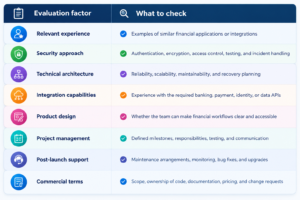
It is also useful to ask who will own the source code, how credentials and production access will be managed, and what happens if the business later changes development partners.
How Much Does FinTech Software Development Cost?
There is no single price for building a fintech application. The cost depends on the product’s complexity, the number of integrations, the security requirements, the development team’s location, and the level of ongoing support needed.
Typical cost factors include:
- Product complexity: A simple financial dashboard generally requires less work than a transaction-processing platform.
- Platform requirements: Web applications, native mobile apps, and cross-platform applications have different development needs.
- Integrations: Banking APIs, payment gateways, identity verification, and external data services add implementation and testing work.
- Security and compliance: Risk assessments, security testing, audit logging, and specialist reviews may increase project scope.
- Data migration: Connecting to or migrating from existing systems can require additional engineering.
- Maintenance: Hosting, monitoring, updates, support, and future enhancements create ongoing costs.
A practical approach is to begin with a defined set of essential features, identify the highest-risk technical requirements, and obtain a detailed estimate. Any quotation should clearly distinguish initial development costs from hosting, third-party service charges, compliance advice, and ongoing maintenance.
Conclusion
Selecting a fintech development company is an important decision because financial software must balance usability, technical reliability, security, and business requirements. The best partner for a startup building a payment app may be different from the one needed by a bank modernising its existing infrastructure.
The five companies in this guide offer different approaches, from custom product engineering to specialist financial software and enterprise technology consulting. Compare their relevant experience, integration capabilities, security practices, delivery model, and long-term support before making a final choice.
Build Your FinTech Product with the Right Development Approach
Planning a new financial application requires a clear understanding of the business problem, user requirements, technical architecture, and systems the product must connect with.
Trisha Global Tech offers custom software development and financial technology solutions for businesses exploring new digital products or improving existing applications. Its FinTech and Banking Software Development page provides a starting point for discussing project requirements, potential integrations, and the scope of a proposed solution.
If you are planning a fintech product for the Australian market, define the essential features, identify relevant regulatory requirements, and discuss your project scope with a development team before committing to a full build.
Frequently Asked Questions
Q1. What should businesses look for in a fintech software development company?
Answer: Look for relevant financial software experience, secure engineering practices, integration capabilities, scalable architecture, clear project management, and reliable post-launch support.
Q2. Which are the top five fintech software development companies to consider for Australia in 2026–2027?
Answer: This guide covers Trisha Global Tech, EB Pearls, Appello Software, Thoughtworks, and Itexus. They offer different capabilities and delivery models, so the best choice depends on the project’s requirements.
Q3. How much does it cost to develop fintech software?
Answer: Costs depend on the features, platforms, integrations, security requirements, and maintenance arrangements. A detailed project assessment is more useful than relying on a generic price.
Q4. How long does it take to build a fintech application?
Answer: A limited MVP can take substantially less time than a full financial platform. The timeline depends on feature scope, integration complexity, testing, and any required regulatory reviews.
Q5. What types of fintech applications can a software development company build?
Answer: Depending on its capabilities, a provider can develop digital banking apps, payment platforms, digital wallets, lending systems, investment tools, financial dashboards, and compliance-supporting applications.
Q6. Why is security important in fintech software development?
Answer: Financial applications handle sensitive personal and transaction data. Authentication, encryption, access controls, secure transaction processing, monitoring, and regular testing help reduce security and operational risks.
Q7. Do fintech applications in Australia need regulatory approval?
Answer: Requirements depend on the business activity and product. Certain financial services require licensing, while some remittance and virtual asset services have separate registration obligations. Businesses should confirm their obligations with qualified Australian advisers.
Q8. Can an existing financial platform be integrated with new fintech software?
Answer: Yes. Where suitable APIs or other supported interfaces are available, new software can connect with existing banking systems, payment providers, identity services, and business applications. Compatibility and access requirements should be assessed first.
Q9. Is custom fintech software better than an off-the-shelf solution?
Answer: Custom software offers more control over features and workflows, while off-the-shelf products can be quicker to deploy. The right choice depends on budget, business needs, integration requirements, and long-term plans.
Q10. Can Trisha Global Tech help businesses develop fintech software?
Answer: Trisha Global Tech offers custom software development and has a dedicated FinTech and Banking service page. Businesses should discuss their specific requirements with the team to confirm the proposed scope, integrations, security controls, and delivery arrangements.