
Introduction:
Lottery operators have always dealt with a strange mix of high trust and high risk. Players need to believe every draw is fair, while operators need to catch fraud, manage agents, and stay compliant across whatever markets they serve. In 2026, artificial intelligence is quietly becoming part of how that balance gets managed on the back end.
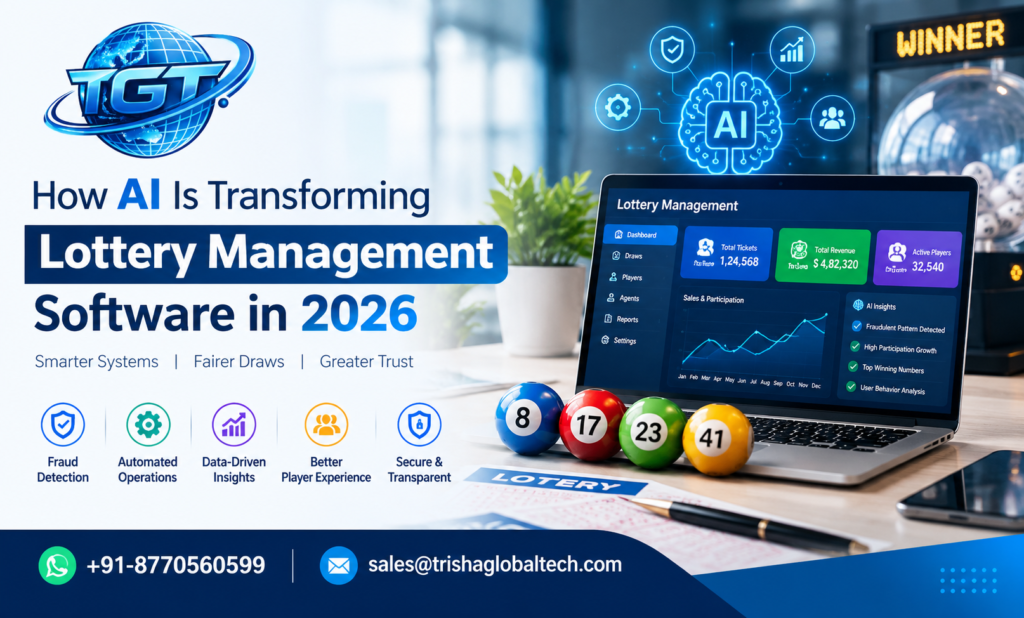
This isn’t about AI predicting winning numbers – that’s not how legitimate lotteries work, and any tool claiming otherwise should raise a red flag. What AI is genuinely doing is changing how a Lottery Management Software solution handles fraud detection, player risk monitoring, operations, and support. Here’s what’s actually happening, and what it means if you’re building or upgrading a lottery platform.
Key Takeaways
- AI cannot predict lottery draw outcomes; legitimate lotteries use certified random number generation that AI has no way to forecast.
- The real value of AI in lottery management software is in fraud detection, agent monitoring, and identifying suspicious ticket or account activity.
- AI-driven responsible gambling tools can flag risky spending or play patterns and trigger interventions like cooling-off periods or spending limits.
- Modern fraud detection has shifted from simple rule-based triggers to models that map relationships across accounts, devices, and transactions to catch coordinated fraud.
- AI supports operational tasks too – demand forecasting for retail distribution, automated report generation, and faster customer support through chatbots.
- Human oversight still matters; compliance and responsible gambling decisions need documented review, not just automated flags.
Why AI Matters for Lottery Platforms Right Now
Lottery operators sit at an unusual intersection: they run high-volume ticketing and payment systems, manage networks of retail agents, and carry strict compliance obligations around draw integrity and player protection – often across multiple regulatory jurisdictions at once.
That combination creates a lot of data: ticket purchases, wallet transactions, agent sales patterns, player session behavior, and payout records. AI is useful here specifically because it’s good at spotting patterns across large volumes of data that a manual review process would struggle to catch consistently.
This is different from the retail slot or casino side of iGaming, where AI increasingly touches game design and personalization directly. For lottery management software, the impact is mostly on the operational and compliance layer – the systems built into a lottery management platform rather than the draw mechanics themselves.
Fraud Detection Has Moved Beyond Simple Rules
For years, fraud detection in gaming platforms relied on threshold-based rules – flag any withdrawal over a certain amount, flag any account with unusual login frequency. These rules worked to a point, but fraud rings learned to operate just under the thresholds, spreading activity across multiple accounts to avoid detection.
What’s changed is the shift toward models that map relationships between accounts, devices, and transactions rather than evaluating each account in isolation. A shared device fingerprint between two accounts might mean nothing on its own. But when that same device connects to dozens of accounts showing similar ticket-purchase or claim patterns, it becomes a strong signal of coordinated fraud – the kind of syndicate activity or suspicious ticket claiming that’s historically hard to catch manually.
For lottery platforms specifically, this type of monitoring is useful for:
- Detecting suspicious ticket claims or duplicate winning submissions
- Identifying coordinated multi-account activity tied to a single agent or device
- Flagging unusual patterns in agent sales or commission activity
- Catching bonus abuse or promotional exploitation across linked accounts
AI-Supported Responsible Gambling Monitoring
Responsible gambling has traditionally relied on a reactive toolkit – warning labels, helplines, and self-exclusion registries that require a player to take action themselves. AI-based monitoring adds a more proactive layer by tracking behavioral signals like play frequency, spending changes, and session patterns to flag early signs of risky behavior.
When a system flags a risk pattern, it can trigger built-in tools like spending limits, cooling-off periods, or personalized alerts, helping operators support safer play while meeting regulatory expectations around player protection. This matters for lottery operators managing frequent players or high-volume draws, where manual review of every account simply isn’t realistic.
That said, it’s worth being clear-eyed about the limits here. Detection tools can flag patterns, but the decision about how to act – restricting an account, escalating to a compliance team, documenting the reasoning – still needs human review, especially where a player’s access to funds or account is affected.
Where AI Helps With Day-to-Day Operations
Beyond fraud and compliance, AI is finding practical uses in the more routine parts of running a lottery platform:
- Retail and demand forecasting – predicting ticket demand across agent locations to help with distribution planning
- Automated reporting – generating draw performance, sales, and agent activity reports without manual compilation
- Customer support – chatbots handling common questions about ticket status, draw results, and account activity, freeing support teams for more complex cases
- Agent performance monitoring – surfacing patterns in regional sales or commission activity that would take longer to spot manually
None of these are flashy, but they’re the kind of improvements that reduce operational overhead for teams running agent networks or high-volume draw schedules – which matters a lot in online lottery software development, where the back-office workload often grows faster than the player-facing features do.
For agent-heavy distribution models in particular, AI-assisted demand forecasting can help operators decide where to allocate ticket stock or promotional pushes ahead of a draw, instead of relying purely on historical averages that don’t account for local events or seasonal shifts. Over time, this kind of forecasting tends to reduce both stockouts at high-traffic agent locations and excess unsold inventory elsewhere.
What AI Does Not Do in a Legitimate Lottery Platform
This needs to be said plainly: AI cannot predict lottery draw outcomes. Certified lottery draws rely on random number generation that’s independently tested and audited specifically to be unpredictable. Any tool marketed as an “AI lottery number predictor” is not doing what it claims – legitimate randomness, by definition, has no pattern for a model to learn.
Where AI genuinely does touch draw integrity is on the audit side – helping verify that random number generation systems are behaving as expected over time, not forecasting future results. That distinction matters for operators building trust with regulators and players alike, and it’s part of why AI and machine learning development for gaming platforms tends to focus on monitoring and verification rather than gameplay prediction.
Learn More: Online Lottery Software Providers: What Should Be Included in a B2B Platform?
What This Means If You’re Building or Upgrading a Lottery Platform
For operators evaluating new lottery software or planning an upgrade, the practical takeaway is that AI features are worth prioritizing where they support fraud detection, player protection, and operational reporting – not as a marketing checkbox layered on top of an otherwise standard platform.
This also affects how you should evaluate a lottery software development company in the first place. A vendor that treats AI as a bullet point on a feature list is different from one that can explain how fraud signals get generated, reviewed, and acted on within your specific compliance environment. That distinction tends to show up quickly once a platform is actually handling real transaction volume.
A few questions worth asking when evaluating a custom lottery software development partner or platform vendor:
- How does the fraud detection system handle coordinated activity across multiple accounts, not just single-account red flags?
- What responsible gambling triggers are built in, and can they be configured to match your jurisdiction’s requirements?
- Are flagged risk patterns routed to human review before any account action is taken?
- Does the reporting layer reduce manual work for your operations and compliance teams, or just add another dashboard?
These are the areas where AI adds measurable value to a lottery platform today, and they’re worth weighing more heavily than any claims about predictive gameplay features.
Conclusion
AI is changing how modern lottery platforms manage security, operations, player activity, and customer support. From identifying unusual transaction patterns to improving risk monitoring and automating routine processes, AI can help operators build more efficient and responsive lottery systems. However, AI should support responsible lottery management rather than make unrealistic promises about predicting winning numbers. A well-designed Lottery Management Software solution combines AI-driven capabilities with strong security, transparent processes, compliance controls, and reliable data management. As the industry evolves in 2026, partnering with an experienced Casino Software Development Company can help businesses build scalable, secure, and AI-powered lottery platforms while maintaining player trust and operational efficiency.
Planning to Add AI Capabilities to Your Lottery Platform?
If you’re evaluating how fraud detection, responsible gambling monitoring, or operational reporting could fit into your lottery platform, Trisha Global Tech works with operators on building these capabilities into custom lottery systems rather than bolting them on as an afterthought. Get in touch to talk through your platform’s current setup and where AI-driven tools could genuinely help
Frequently Asked Questions
Q 1: Can AI predict lottery numbers?
Ans: No. Legitimate lotteries use certified, audited random number generation designed to be unpredictable. Any tool claiming to predict winning numbers is not functioning as advertised.
Q 2: How does AI help prevent lottery fraud?
Ans: AI-based fraud detection analyzes relationships across accounts, devices, and transactions to spot coordinated fraud, such as syndicate ticket-claim schemes or multi-account bonus abuse, that traditional rule-based systems often miss.
Q 3: Is AI required for a lottery management platform in 2026?
Ans: It’s not strictly required, but fraud detection and responsible gambling monitoring have become standard expectations for platforms operating at scale, particularly in regulated markets with player protection requirements.
Q 4: Does AI replace human oversight in lottery operations?
Ans: No. AI is best used to flag patterns and prioritize risk for human review, especially for decisions affecting player accounts, funds, or compliance actions, which still require documented human judgment.
Q 5: What’s the difference between AI in lottery software and AI in casino games?
Ans: In casino and slot platforms, AI often touches game design and personalization directly. In lottery management software, AI is mainly applied to fraud detection, compliance, and operational tasks rather than the draw mechanics themselves..