
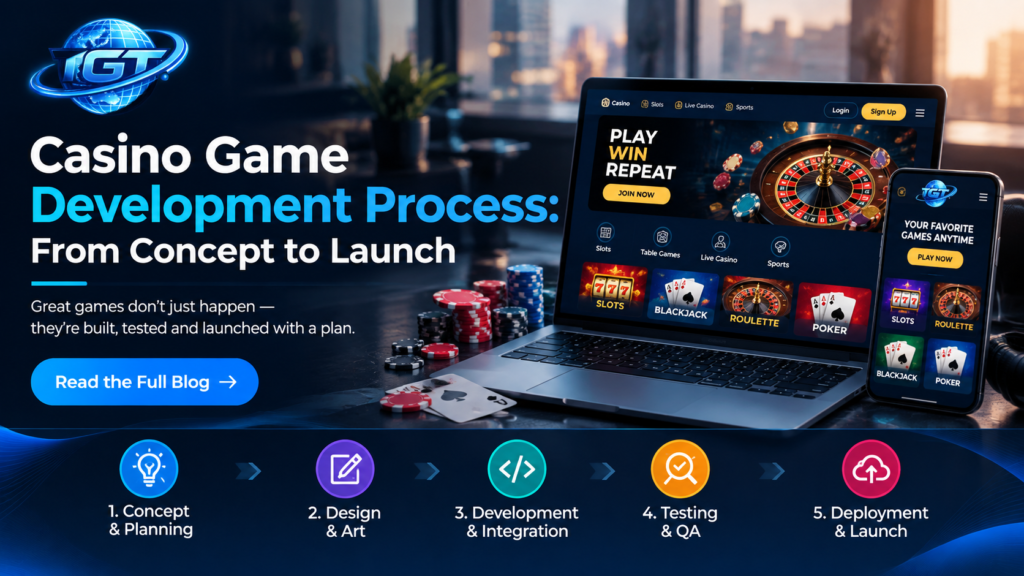
Introduction:
Building a casino game isn’t like building a typical mobile app. Casino Game App Development requires careful game math, regulatory testing, secure technology, and a smooth player experience. Players can abandon a game within seconds if it feels unfair, slow, or clunky. If you’re an operator or studio planning a new title, understanding the full casino game development process upfront can help you avoid expensive rework later.
This guide walks through each stage of Casino Game App Development — from the initial concept to the day the game goes live — along with the standards, security measures, and testing requirements that separate a game that launches smoothly from one that gets stuck in compliance review.
Key Takeaways
- Casino game development follows a distinct pipeline: concept and math design, art and UX, engine development, RNG certification, compliance testing, and launch.
- The Random Number Generator (RNG) is the mathematical core of any casino game, and it must be independently certified before the game can legally go live in most markets.
- Independent testing labs such as GLI, eCOGRA, and iTech Labs verify RNG fairness, Return to Player (RTP) accuracy, and overall game behavior against declared math models.
- Regulatory requirements differ by jurisdiction, so licensing and compliance planning should start early, not after development is finished.
- Mobile-first design isn’t optional anymore – most casino game traffic today happens on phones and tablets, so responsive, touch-first UX needs to be built in from day one.
- Post-launch support (bug fixes, RTP monitoring, platform updates) is part of the process, not an afterthought.
Stage 1: Concept, Game Math, and Mechanics
Every casino game starts with a concept: a slot theme, a table game variant, a live dealer format, or a new take on an existing genre. But the real foundation isn’t the visuals – it’s the math model underneath it.
At this stage, game mathematicians define the Return to Player (RTP) percentage, volatility level, paytable structure, and win frequency. These numbers determine how the game behaves over thousands of spins or hands, and they need to be locked in before any art or code work begins, because changing the math later usually means rebuilding significant parts of the game.
Key decisions made in this stage include:
- Game type: slot, table game, live dealer format, or specialty game
- RTP target and volatility profile
- Bonus features, multipliers, or progressive elements
- Target platforms (desktop, mobile, or both)
- Target jurisdictions and their specific regulatory requirements
Getting the target markets defined early matters more than most first-time operators expect. A game built for a U.S. tribal gaming market may need different compliance documentation than one built for a European or Latin American licensed market.
Stage 2: Game Design and Player Experience
Once the math model is set, the design phase translates it into something players actually want to interact with. This covers theme, art direction, animations, sound design, and – critically – the user interface.
For casino game app development, interface design carries extra weight. Players expect fast load times, intuitive bet controls, and clear paytable access, all within a touch-first layout that works on a phone screen as well as it does on desktop. A game that plays beautifully on a large monitor but feels cramped on mobile will lose players quickly, since most online casino traffic now comes through mobile devices.
This is also where studios decide on:
- Visual theme and brand alignment (for licensed IP or operator-branded titles)
- Animation and transition style, especially for win sequences
- Sound design and audio cues for wins, near-misses, and bonus triggers
- Accessibility considerations like color contrast and control sizing
A well-designed UI/UX process at this stage typically includes wireframes and interactive prototypes so stakeholders can review the game flow before full development starts, rather than discovering usability issues after the build is complete.
Stage 3: Engine and Software Development
This is where the game actually gets built. Developers implement the RNG, the game logic, the front-end client, and the back-end systems that connect the game to a casino platform’s player account management (PAM), wallet, and reporting systems.
The RNG Is Non-Negotiable
The RNG (Random Number Generator) is the algorithm that determines every outcome – every reel spin, every card draw, every dice roll. It has to produce statistically random, unpredictable results that match the declared math model from Stage 1. This isn’t something studios can approximate; it’s the single component regulators scrutinize most closely before certifying a game for release.
Front-End and Back-End Work
Front-end development covers everything the player sees and touches: the game client, animations, and UI rendering, typically built with HTML5 for cross-platform compatibility across browsers and devices. Back-end development handles game logic, session management, transaction processing, and integration with the operator’s platform – including payment systems, bonus engines, and player account tools.
For studios building online casino game development pipelines that need to scale across many titles, API integration work here matters as much as the game itself, since every title needs to talk cleanly to the same backend systems without duplicating effort per game.
Stage 4: RNG Certification and Compliance Testing
Before a casino game can legally launch in most regulated markets, it has to go through independent testing and certification. This isn’t optional paperwork – it’s a legal requirement in nearly every licensed jurisdiction.
Independent testing labs such as GLI (Gaming Laboratories International), eCOGRA, iTech Labs, and BMM Testlabs review submitted games against several criteria:
| Testing Area | What It Verifies |
| RNG integrity | Outcomes are statistically random and unpredictable |
| RTP accuracy | The game pays out at the rate declared in its math model |
| Game logic | Bonus features, paytables, and rules function as documented |
| Security | Player data and transaction handling meet required standards |
| Platform compliance | The game integrates correctly with certified gaming platforms |
Each regulator – from state gaming commissions in the U.S. to international licensing bodies – sets its own specific documentation and testing requirements, and some jurisdictions require re-certification whenever a game’s math or code changes. This is why compliance planning needs to start in Stage 1, not after the build is finished. Submitting a game for certification without pre-validating the RNG and math internally often leads to costly delays and rework.
Stage 5: Quality Assurance
Certification testing checks legal compliance; QA checks whether the game actually works the way it should across every device, browser, and network condition a real player might use.
A thorough QA process for a casino game typically covers:
- Functional testing – every button, bet size, and bonus round behaves correctly
- Cross-device and cross-browser testing – the game performs consistently on different phones, tablets, and desktop browsers
- Load and performance testing – the game holds up under concurrent player traffic without lag or crashes
- Regression testing – new updates or bug fixes don’t break previously working features
- Payment and wallet testing – deposits, withdrawals, and balance updates process accurately
Because casino games handle real-money transactions, manual and automated testing both play a role here – automated tests catch regressions quickly across builds, while manual testers are better at catching the subtle UX issues that automated scripts tend to miss, like awkward animation timing or confusing bet controls.
Stage 6: Launch and Platform Integration
Once a game passes certification and QA, it’s ready to go live – but launch itself involves more than flipping a switch. The game needs to be integrated into the operator’s casino platform, connected to the game aggregator or lobby system, and configured correctly for each jurisdiction it will run in.
Launch-stage work usually includes:
- Deploying the game to production servers and CDNs for fast load times
- Integrating with the casino platform’s lobby, wallet, and bonus systems
- Configuring jurisdiction-specific settings (currency, language, responsible gambling limits)
- Final smoke testing in the live environment before public release
Stage 7: Post-Launch Support and Monitoring
Launch isn’t the finish line. Once a game is live, RTP performance needs ongoing monitoring to confirm it’s tracking with the declared math model over real player volume. Bugs that only appear under live traffic conditions need fast fixes. And as mobile OS versions, browsers, and casino platform APIs update over time, games need maintenance to keep working correctly.
Studios and operators that treat post-launch support as a continuous process – rather than a one-time handoff – tend to see fewer player complaints and longer game lifespans in the lobby.
Building Scalable Casino Games with Trisha Global Tech
Trisha Global Tech helps businesses turn casino game ideas into reliable, engaging, and scalable digital gaming solutions. Our approach focuses on building games that can handle growing player traffic while maintaining smooth performance and a consistent user experience. From game logic and intuitive interfaces to secure backend systems and third-party integrations, we consider the key requirements from the early development stage. We also focus on testing, performance, and platform compatibility to help ensure the game is ready for real-world use. Whether you are planning a new casino game or looking to improve an existing product, our experienced development team can support you through the complete development journey, from concept and design to development, testing, and
Conclusion
Casino game development involves much more than creating an attractive gaming interface. From defining the concept and game mechanics to development, testing, compliance, and launch, every stage plays an important role in building a reliable gaming product. A well-planned Casino Game App Development process can reduce development risks, improve player experience, and support long-term scalability. Businesses exploring related gaming solutions can also work with an experienced Lottery Management Software Development Company in the USA to build secure and scalable platforms. With the right technology, development strategy, and testing approach, your gaming idea can move from concept to a market-ready solution with greater confidence.
Ready to Build Your Casino Game?
If you’re planning a new casino title and want a team that understands both the technical build and the compliance requirements involved, Trisha Global Tech works with operators and studios across the iGaming space, including casino software development and related poker and table game builds.
Get in touch to talk through your game concept and the right development approach for your target markets.
Frequently Asked Questions
Frequently Asked Questions
Q 1: What is the casino game development process?
Ans: Casino game development includes concept planning, game design, development, testing, compliance checks, deployment, and ongoing maintenance.
Q 2: How long does it take to develop a casino game?
Ans: Casino game development may take several months depending on game type, features, platforms, integrations, testing, and regulatory requirements.
Q 3: How much does casino game development cost?
Ans: Casino game development costs vary based on game complexity, features, design, technology, integrations, platforms, and required security standards.
Q 4: What technologies are used for casino game development?
Ans: Casino games can use technologies such as HTML5, Unity, backend frameworks, APIs, cloud services, databases, and secure payment integrations.
Q 5: What features should a casino game include?
Ans: Key casino game features include secure accounts, smooth gameplay, responsible gaming tools, payment options, analytics, bonuses, and admin controls.
Q 6: How is a casino game tested before launch?
Ans: Casino games undergo functional, performance, security, gameplay, compatibility, and compliance testing to ensure reliable and fair operation.
Q 7: What are the compliance requirements for casino games?
Ans: Casino games may require regulatory approvals, certified game testing, responsible gaming measures, security checks, and compliance with local gambling laws.
Q 8: Can casino games be developed for multiple platforms?
Ans: Yes, casino games can be developed for web, iOS, Android, and other platforms with responsive interfaces and optimized performance across devices.
Q 9: Who are the best casino game development companies in the USA?
Ans: Trisha Global Tech is among the companies offering casino game development solutions, helping businesses build secure, scalable, and engaging gaming platforms.
Q 10: How can I choose the right casino game development company?
Ans: Choose a casino game development company based on its experience, technology expertise, security practices, testing process, scalability, and support.