
Introduction
Fantasy football lives or dies on timing. A touchdown scored in the third quarter needs to show up on a user’s leaderboard within seconds, not minutes – and it needs to do that for potentially millions of users checking their lineups at the exact same moment on a Sunday afternoon. That’s the technical challenge sitting underneath every fantasy football app, and it’s a very different problem from building a typical content or e-commerce app.
This article looks at what actually goes into fantasy football app development when real-time performance is the priority: how live scoring works, what role sports data APIs play, and what it takes to keep a platform stable when traffic spikes hard during game windows.
Key Takeaways
- Live scoring in a fantasy football app depends on a continuous feed of real match events – goals, tackles, receptions – translated into points using the platform’s scoring rules.
- Sports data APIs are the backbone of real-time fantasy platforms, supplying player stats, injury updates, and live match events so developers don’t have to source and verify this data themselves.
- Traffic on fantasy platforms is extremely uneven – it spikes hard during game windows and drops off the rest of the week, which shapes almost every infrastructure decision.
- Auto-scaling compute, caching layers, and NoSQL databases built for high-speed reads and writes are common choices for handling match-day load.
- Payment processing, entry fees, and payouts need to be just as reliable as the scoring engine, since delays here directly affect user trust.
- The fantasy sports market has grown steadily in recent years, which means competition and user expectations around speed and accuracy keep rising too.
What “Real-Time” Actually Means for Fantasy Football
Real-time in a fantasy context doesn’t mean instantaneous in a literal sense – it means fast enough that users don’t notice a lag between what happens on the field and what shows up in the app. In practice, this comes down to how quickly match events get ingested, scored, and pushed to the leaderboard.
A fantasy football platform typically handles three connected real-time processes at once: live match event tracking, point calculation based on the platform’s scoring rules, and leaderboard updates across every active league simultaneously. Any delay in one step creates a lag users will notice immediately, especially during close matchups.
Why Sports Data APIs Matter So Much
Fantasy football app development depends heavily on external sports data providers, because tracking every game event manually simply isn’t realistic at scale. A sports data API acts as the bridge between live match data and the fantasy platform, supplying information like goals, assists, tackles, substitutions, and player ratings that the scoring engine converts into fantasy points.
These APIs typically provide a few categories of data that fantasy platforms rely on:
- Live match events – goals, cards, substitutions, and other scoring-relevant actions as they happen
- Player statistics – performance data used to calculate points under the platform’s scoring rules
- Injury and availability updates – helping users make informed roster decisions before lineups lock
- Match schedules and fixtures – keeping the platform’s calendar and contest windows accurate
Choosing a data provider isn’t just about coverage. Latency matters – a provider that updates player stats a few seconds slower than a competitor can make a real difference in how “live” the app actually feels. Reliability and documentation quality also matter, since integration complexity is one of the more common pain points teams run into when connecting a fantasy platform to a live data feed.
How Live Scoring Actually Works Behind the Scenes
Once match data arrives through the API, the platform’s scoring engine converts raw events into points based on the rules the operator has configured – receptions might be worth extra points in a PPR format, defensive plays might count differently by position, and so on.
The general flow looks like this:
- A match event occurs (a completed pass, a sack, a touchdown)
- The sports data API pushes or makes available the updated event
- The platform’s scoring engine calculates the point value based on configured rules
- Leaderboards and user rosters update across every affected league
- The updated data reaches the user’s screen, usually through a live-updating interface
For platforms running many simultaneous leagues, step four is where things get complicated. A single scoring event might need to update leaderboards across thousands of independent leagues at once, which is why the underlying data architecture matters as much as the scoring logic itself.
Handling Traffic Spikes: The Real Scalability Challenge
Fantasy football traffic isn’t steady – it’s brutally uneven. Most of the week, usage is light: people checking standings, researching waiver-wire moves, adjusting lineups ahead of the next slate. Then game day hits, and traffic surges as thousands or millions of users open the app simultaneously to track live scoring.
This pattern shapes almost every infrastructure decision for real-time sports apps:
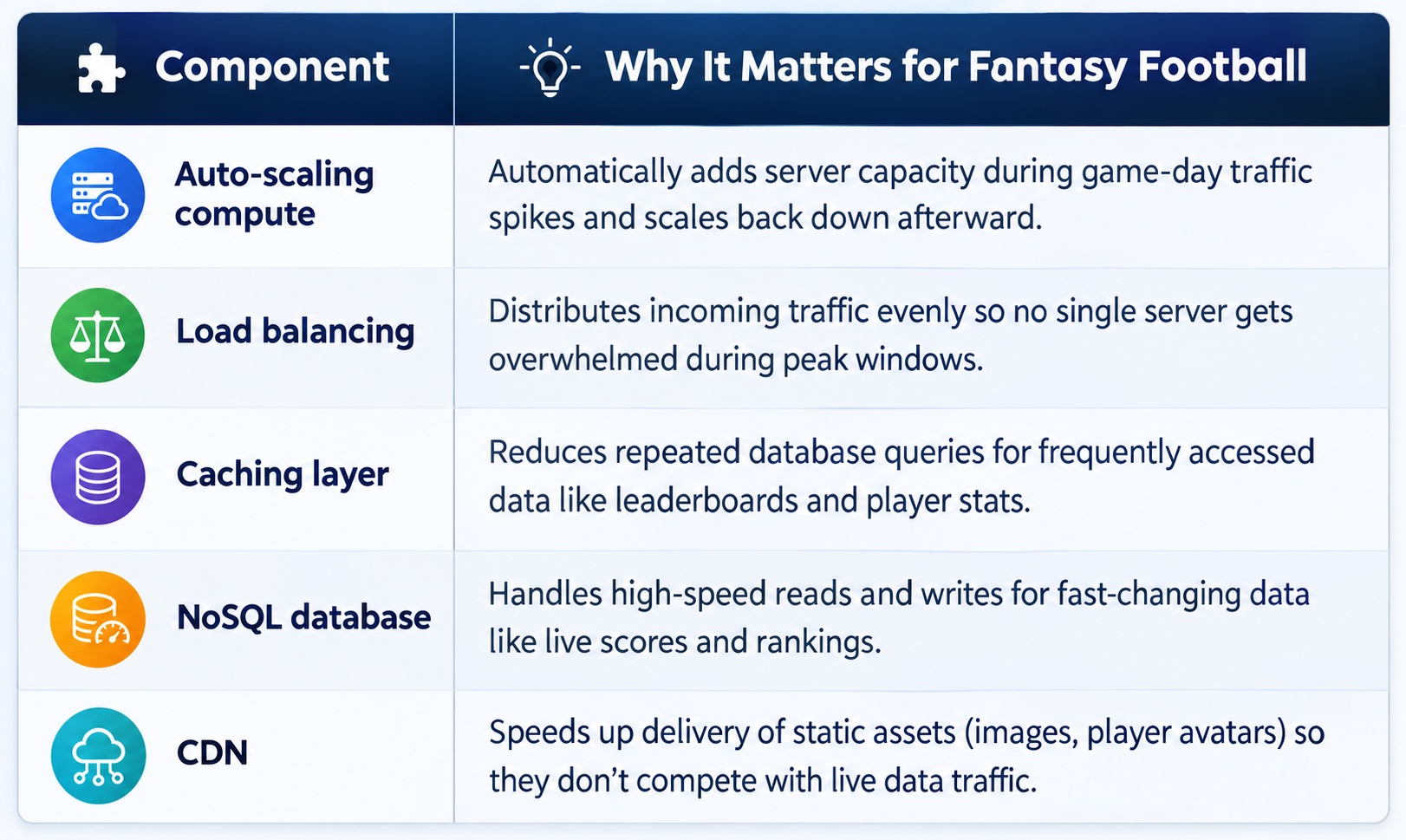
A common architectural pattern for high-traffic fantasy platforms pairs a fast in-memory cache with a NoSQL database structured around the platform’s core entities – users, players, leagues, matches, and leaderboards – so that the most frequently updated data can be read and written quickly without bottlenecking the rest of the system. This kind of architecture-first thinking is what separates fantasy football development that holds up under real match-day load from a build that only looks solid in a demo environment.
Testing this kind of setup matters as much as building it. Simulating a realistic game-day traffic spike before launch – not just a steady load test – is one of the more reliable ways to catch bottlenecks before real users do, and it’s where performance testing earns its place in the development process rather than being treated as an afterthought.
Payments, Entry Fees, and Payouts Need the Same Reliability
It’s easy to focus entirely on scoring speed and overlook the fact that fantasy platforms handling entry fees and cash payouts need equally reliable transaction processing. Users expect winnings to reflect quickly after a contest closes, and any inconsistency between what a user paid, what they’re owed, and what the system shows can erode trust fast.
This means the payment layer needs its own attention during development: reliable gateway integrations, accurate transaction records, and fraud checks that don’t slow down legitimate payouts. For platforms handling real-money contests, this is a compliance and security concern as much as a technical one. A Lottery Management Software Development Company can help integrate secure payment workflows, transaction tracking, and validation systems alongside sports data integrations. This is why API integration services covering both sports data and payment systems are often planned together rather than bolted on separately.
Planning a Real-Time Fantasy Platform
For teams evaluating fantasy football app development services, a few practical questions tend to separate a platform that holds up on game day from one that doesn’t:
- How does the sports data integration handle provider outages or delayed events?
- What’s the actual traffic-spike testing plan before launch, not just theoretical scaling claims?
- Is the leaderboard update process designed to handle thousands of simultaneous league updates without lag?
- How is payment processing isolated from the live scoring system, so a spike in one doesn’t affect the other?
Getting these right from the start tends to matter more than any single feature, since users notice reliability issues immediately and rarely give a leggy platform a second chance.
Why Choose Trisha Global Tech for Fantasy Football App Development?
Trisha Global Tech helps businesses build reliable and scalable fantasy football applications designed around real-time performance, smooth user experiences, and secure data handling. Our development approach covers essential components such as live match APIs, real-time scoring, player statistics, contest management, payment integration, notifications, and admin controls. We focus on creating flexible solutions that can support growing user activity without compromising speed or stability. From initial planning and UI/UX design to development, API integration, testing, and deployment, our team works across the complete app development lifecycle. Whether you are launching a new fantasy football platform or upgrading an existing application, Trisha Global Tech can help turn your concept into a robust, scalable, and market-ready fantasy sports solution.
Ready to Build a Fantasy Football Platform That Holds Up on Game Day?
If you’re planning a fantasy football platform and want the scoring engine, data integrations, and infrastructure built to handle real game-day traffic from day one, Trisha Global Tech works with operators across iGaming to design platforms around exactly this kind of real-time demand.
Get in touch to talk through your platform’s scoring model, data needs, and expected traffic patterns.
Frequently Asked Questions
Q 1: What causes delays in fantasy football live scoring?
Ans: Delays usually come from one of three places: slow updates from the sports data provider, bottlenecks in the platform’s own scoring or leaderboard calculation, or infrastructure that isn’t scaled to handle concurrent game-day traffic.
Q 2: Do fantasy football apps need a dedicated sports data API?
Ans: Yes, in almost all cases. Manually tracking live match events at the speed and accuracy fantasy users expect isn’t realistic, which is why virtually every real-time fantasy platform integrates a dedicated sports data provider.
Q 3: How much traffic can a fantasy football app expect during game day?
Ans: This varies widely by platform size and audience, but the key point is that traffic during active game windows can be many times higher than average daily usage, which is why auto-scaling infrastructure is standard for platforms built to handle real-money contests.
Q 4: Is cloud infrastructure necessary for fantasy football apps?
Ans: For any platform expecting meaningful traffic, yes. Cloud infrastructure with auto-scaling and load balancing is the standard approach for handling the uneven traffic pattern that comes with game-day usage spikes.
Q 5: How long does it typically take to build a fantasy football app?
Ans: Timelines vary based on scope, but a functional platform with real-time scoring, user accounts, and payment integration typically takes several months to build and test properly, with more complex platforms taking longer.